Listening to the Voice of Nature: Why Love Requires Law

"Elephanatics Foundation - Free elephant conservation lesson plans, toolkits for teachers, and persuasive essay resources."
Mother elephant with her calf.

When you look into the eyes of a wild elephant, you get an overwhelming sense of your own humility. During a trip to Kenya’s Maasai Mara, a matriarch charged our jeep, stopping just three feet away. In that heart-stopping moment, our eyes met—a stark reminder that we are in their world, and the only way to truly protect nature and wildlife is to listen to it.

Today, that protection is failing on a global scale. Transnational crime syndicates generate $199 billion annually through illegal wildlife trafficking—often operating through the same organized networks that smuggle weapons, illicit drugs, and human beings, taking advantage of weak laws and low penalties.

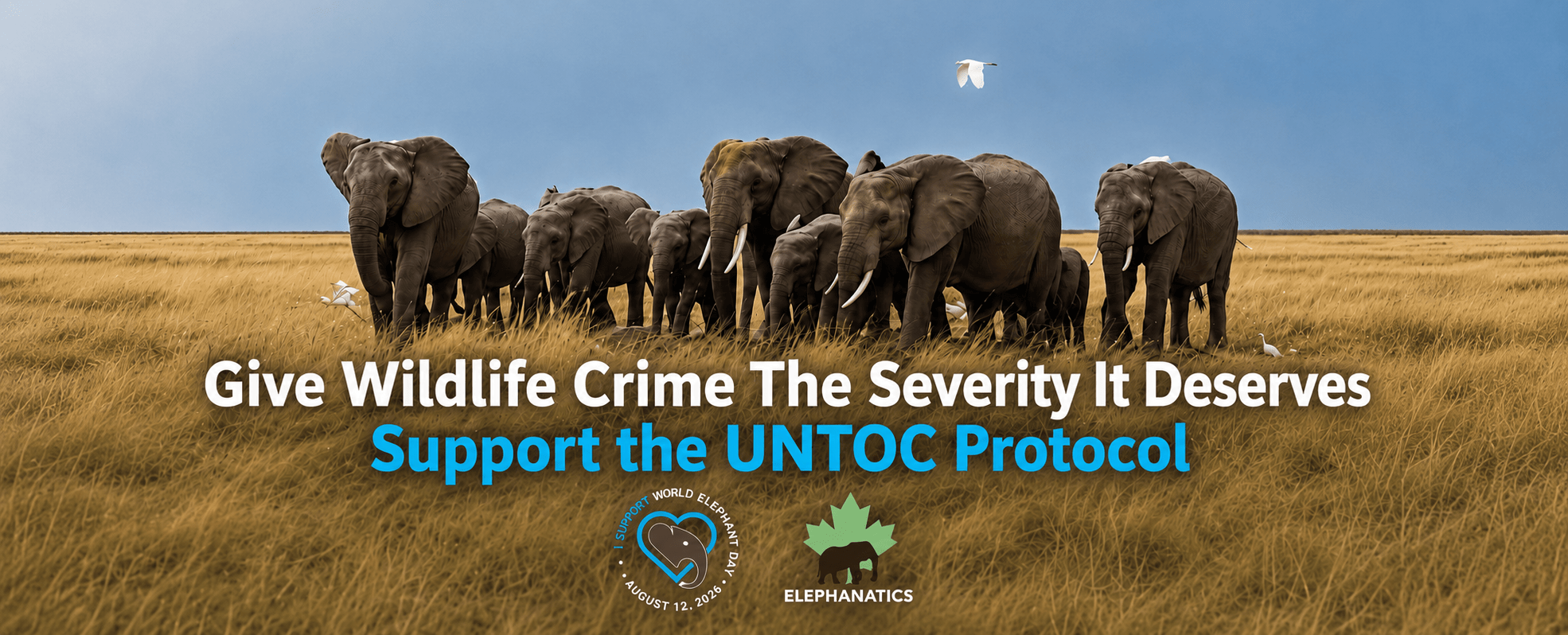
Elephanatics and World Elephant Day have collaborated to rally Canadians to demand our government support a binding Wildlife Crime Protocol under the United Nations Convention against Transnational Organized Crime (UNTOC). With crucial discussions unfolding at the UN Commission on Crime Prevention and Criminal Justice (CCPCJ) this September and leading directly into the 13th Conference of the Parties (COP13) in Vienna this October, your local Member of Parliament needs to hear from you today.

🚨 TAKE 30 SECONDS TO EMAIL YOUR MP NOW 🚨 

  • Click Here to Send the English Letter
  • Cliquez ici pour envoyer la lettre en français

(Your letter is automatically formatted and sent directly to your local Member of Parliament based on your postal code.)

Why We Need Action Ahead of CCPCJ & UNTOC COP13

Today, transnational wildlife trafficking is a multi-billion-dollar criminal enterprise. Poachers and organized syndicates exploit legal loopholes across borders, pushing vulnerable species toward extinction worldwide because international law continues to treat wildlife crime as a minor offense.

After an eight-year campaign, Elephanatics successfully helped push through strict new regulations to end Canada’s trade in elephant ivory and rhino horn in 2024. Now, we must finish the job on the global stage.

A legally binding UNTOC Protocol will:

  • Close Legal Loopholes: Harmonize global laws so traffickers cannot hide behind weak borders.

  • Target Syndicates: Give law enforcement cross-border intelligence tools to freeze cartel assets.

  • Impose Severe Penalties: Treat wildlife crime with the exact same legal severity as human, arms, and drug trafficking.

Stand With Us Before the Fall UN Summits

I will never forget the moment nature challenged me to respect its voice. Now, decision-makers in Ottawa need to hear yours.

👉 Click Here to Email Your MP in English

👉 Cliquez ici pour envoyer la lettre en français

Thank you for taking action today. Every single letter brings us one step closer to real justice.

Fran Duthie

President, Elephanatics Foundation
 

Empowering youth to speak up for wildlife: Our Back-to-School launch

Empowering Tomorrow’s Change-Makers Today 🍁🐘

As students across British Columbia return to the classroom this September, Elephanatics, in partnership with World Elephant Day, is launching our most crucial educational initiative yet: the Wildlife Crime Civic Action Student Toolkit.

Wildlife trafficking is one of the most lucrative transnational crimes in the world, threatening keystone species like African elephants and destabilizing fragile ecosystems. Real change requires systemic international policy—and our youth have a vital role to play in driving that conversation.

Why This Matters to Every Single One of Us 🌍

It is easy to view wildlife trafficking strictly as an animal welfare issue, but wildlife crime is environmental crime. Elephants and other keystone species are the vital pillars holding entire ecosystems together—ecosystems that produce our clean air, store carbon, maintain soil health, and protect global water cycles.

When criminal syndicates strip ecosystems of their natural biodiversity, they accelerate ecological collapse, increase human exposure to zoonotic diseases, and threaten local communities dependent on natural resources. Fighting for a global UNTOC Wildlife Crime Protocol isn’t just about protecting iconic species; it is about defending the natural systems that sustain human life and safeguarding our shared planet against organized environmental destruction.

A Free, Hands-On Resource for Secondary Classrooms 📚

Designed for Grades 6–12 Science, Social Studies, and English Language Arts, this interdisciplinary resource connects classroom learning directly with real-world civic engagement.

Through engaging modules, students will explore:

  • 🌾 Environmental Crime & Ecosystems: How transnational wildlife trafficking destabilizes global ecosystems, economic security, and public health.

  • 🌐 Organized Crime Syndicates: How multi-billion-dollar criminal networks exploit legal gaps across international borders.

  • ✍️ Civic Action & Democracy: The power of democratic participation through targeted advocacy letter-writing to Canadian government leaders.

Why the Timing Matters ⏳

This October, world leaders are gathering for a major global summit on international organized crime. Ahead of this critical summit, Canadian students have a unique window of opportunity to make their voices heard by writing directly to decision-makers and Members of Parliament, advocating for stronger global laws to shut down wildlife trafficking networks.

How You Can Help Drive Immediate Impact 🚀

Whether you are an educator, parent, or supporter, here is how you can help us reach classrooms this fall:

  • 📣 Share the Toolkit with Teachers: Pass our free curriculum package along to secondary educators, science coordinators, or school principals in your community.

  • 📥 Download the Materials: Explore the lesson plan and letter-writing guides directly on our website.

  • 🌐 Spread the Word: Share our campaign link on social media to build momentum.

👉 Access the Free UNTOC Student Toolkit Here: https://elephanatics.org/untoc-toolkit/#BTS

Thank you for continuing to stand with us as we empower the next generation of global citizens to protect our planet’s wildlife.

Warm regards,

Fran Duthie

President, Elephanatics

Fellow, Royal Canadian Geographical Society

#WorldEnviornmentDay June 5th, 2023 #BeatPlasticPollution

June 5th is #WorldEnvironmentDay

The theme of World Environment Day 2023 is to focus on solutions to plastic pollution. #BeatPlasticPollution 

Plastic is being consumed in large amounts by elephants primarily in Asia and India largely due to increased population growth which has caused habitat loss, fragmentation, and forced elephants to search for food in unhealthy places.

As this video  will explain, in Sri Lanka alone, elephants have been found to consume enormous amounts of plastic from toxic waste sites causing them a horrific painful death. In India, elephants consume plastics from nearby village dumps and transport them deep into forests. 

85 percent of waste found in elephant dung in the town of Kotdwar, India, was plastic. This has a cascading effect on other animals feeding off their dung and is a leading concern of what the effects of plastic are on land ecosystems. 

Because elephants are prolific seed dispersers and a keystone species responsible for the ecosystems in which they live, plastic is a grave danger to all species involved in the chain reaction.

The Organization for Economic Co-operation and Development (OECD) has stated that the amount of plastic that is produced annually is set to triple by 2060, driven by rising populations and income. 

In their report they propose concrete policies that can be implemented along the lifecycle of plastics that could significantly curb, or even eliminate, plastic leakage into the environment. What can we all do to expedite some of the initiatives and policies outlined in this report? 

Set a personal #Goal to help end #PlasticConsumption and #BeatPlasticPollution 

  • Adopt a circular lifestyle. … meaning reuse the waste that you produce instead of filling up landfills and oceans and exploiting raw materials.
  • Rethink your fashion and laundry choices…buy second hand.
  • Make sure your toiletries are plastic-free.
  • Say “no” to plastic when shopping. … take your own bag!!
  • Don’t accept plastic containers for takeout … approach owner of business and encourage them to purchase cardboard takeaway containers … a great example of environmental, social, and governance strategy (ESG) is Snooze, a restaurant who has been a leader in ESG for years. Support restaurants like this who are making necessary transitions for a healthier planet!
  • Roll up your sleeves and get cleaning. … volunteer with an organization who does plastic clean up.
  • Recycle!
  • Join the UN Environment Programme’s (UNEP’s) Clean Seas campaign.
  • Support an elephant conservation organization – Elephanatics – whose core values and beliefs are:

Sustainability – Environmental and social sustainability are our core values and is reflected in    the work we do and how we do it.
Professionalism – Being transparent, accountable, and responsible for all we do within      our organization and how we project that through the work we do.
Community – Our community of social media followers, partners, and volunteers are key      components in achieving our goals of spreading awareness and holding fundraising events. Education is key to change and must be done in a compassionate, environmentally friendly, manner.

Enjoy World Environment Day by setting a goal to make the world a better place for all of us, especially elephants!