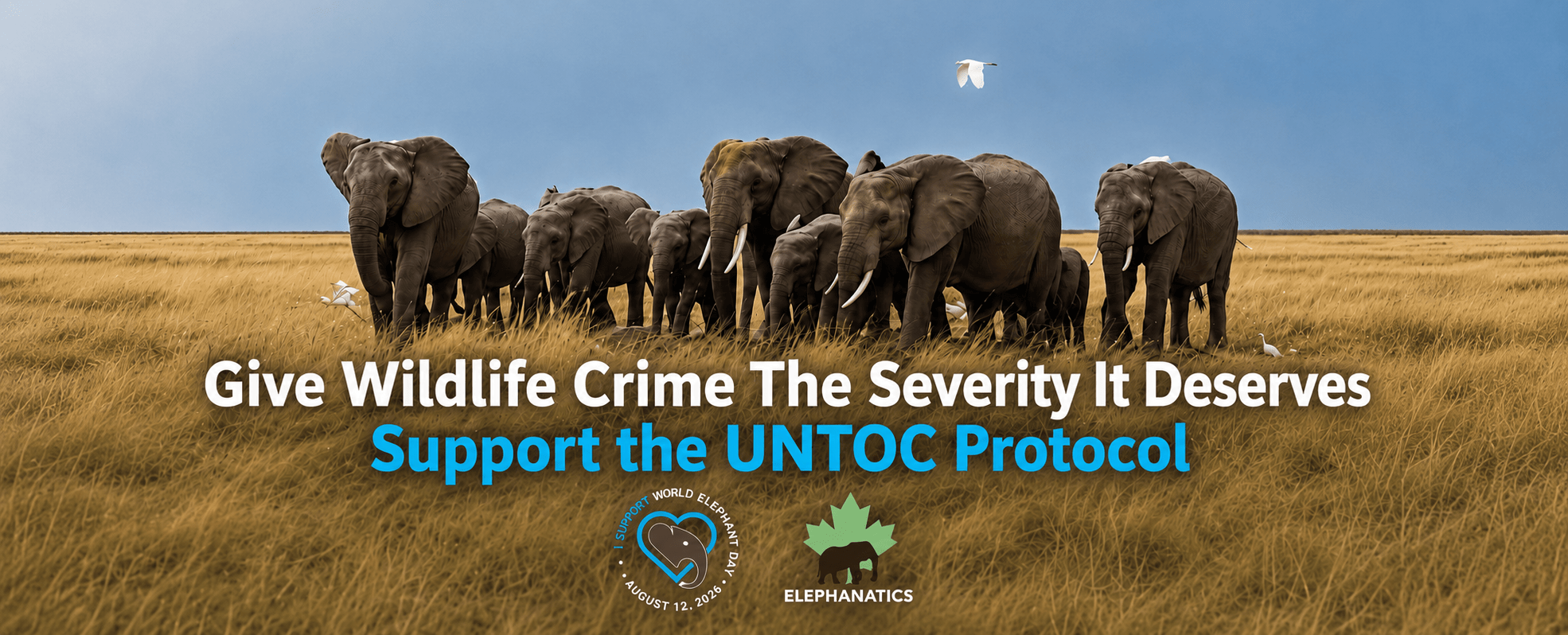
When you look into the eyes of a wild elephant, you get an overwhelming sense of your own humility. During a trip to Kenya’s Maasai Mara, a matriarch charged our jeep, stopping just three feet away. In that heart-stopping moment, our eyes met—a stark reminder that we are in their world, and the only way to truly protect nature and wildlife is to listen to it.
Today, that protection is failing on a global scale. Transnational crime syndicates generate $199 billion annually through illegal wildlife trafficking—often operating through the same organized networks that smuggle weapons, illicit drugs, and human beings, taking advantage of weak laws and low penalties.
Elephanatics and World Elephant Day have collaborated to rally Canadians to demand our government support a binding Wildlife Crime Protocol under the United Nations Convention against Transnational Organized Crime (UNTOC). With crucial discussions unfolding at the UN Commission on Crime Prevention and Criminal Justice (CCPCJ) this September and leading directly into the 13th Conference of the Parties (COP13) in Vienna this October, your local Member of Parliament needs to hear from you today.
🚨 TAKE 30 SECONDS TO EMAIL YOUR MP NOW 🚨
(Your letter is automatically formatted and sent directly to your local Member of Parliament based on your postal code.)
Why We Need Action Ahead of CCPCJ & UNTOC COP13
Today, transnational wildlife trafficking is a multi-billion-dollar criminal enterprise. Poachers and organized syndicates exploit legal loopholes across borders, pushing vulnerable species toward extinction worldwide because international law continues to treat wildlife crime as a minor offense.
After an eight-year campaign, Elephanatics successfully helped push through strict new regulations to end Canada’s trade in elephant ivory and rhino horn in 2024. Now, we must finish the job on the global stage.
A legally binding UNTOC Protocol will:
-
Close Legal Loopholes: Harmonize global laws so traffickers cannot hide behind weak borders.
-
Target Syndicates: Give law enforcement cross-border intelligence tools to freeze cartel assets.
-
Impose Severe Penalties: Treat wildlife crime with the exact same legal severity as human, arms, and drug trafficking.
Stand With Us Before the Fall UN Summits
I will never forget the moment nature challenged me to respect its voice. Now, decision-makers in Ottawa need to hear yours.
👉 Click Here to Email Your MP in English
👉 Cliquez ici pour envoyer la lettre en français
Thank you for taking action today. Every single letter brings us one step closer to real justice.
Fran Duthie
President, Elephanatics Foundation