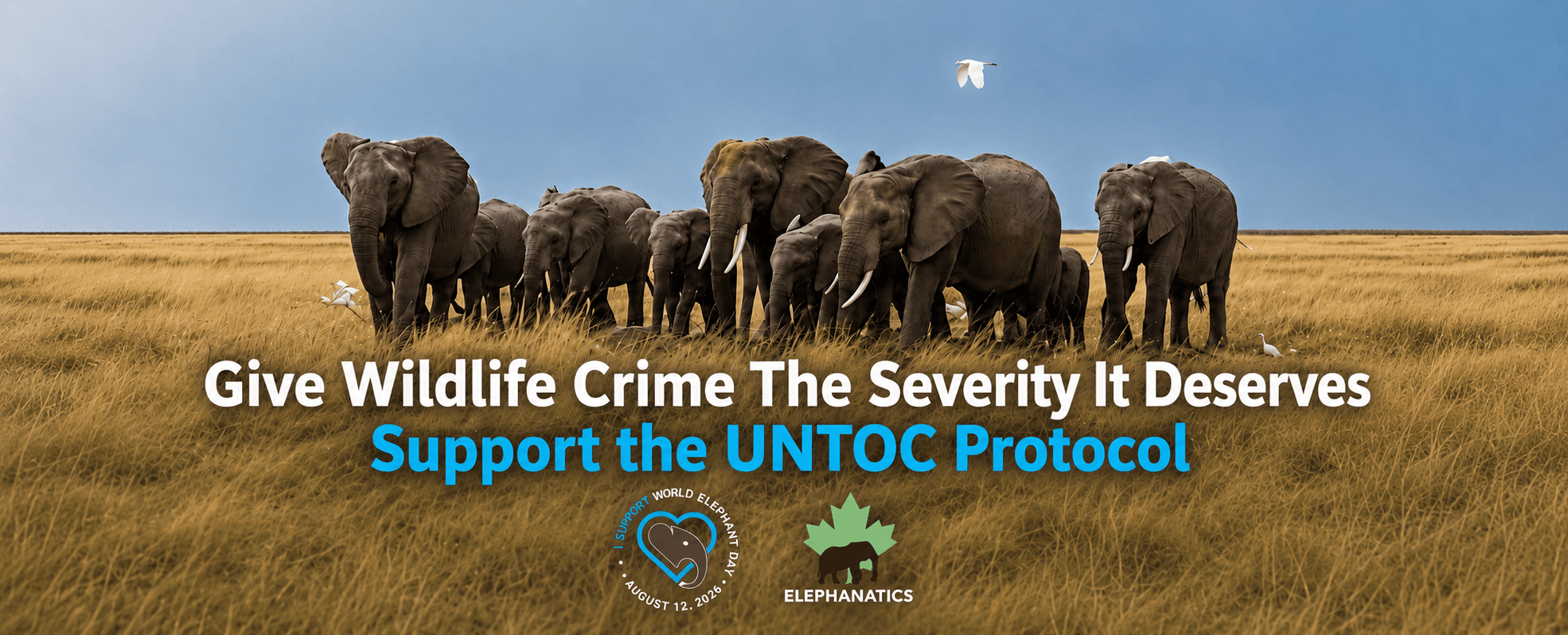
Historic Victory: Canada Votes YES to Launch UN Treaty Negotiations Against Environmental Crime

Great news!
we would like to Thank Everyone Who Supported Our ‘Give Wildlife Crime The Severity That It Deserves’ Campaign!

As the Conference of the Parties to the United Nations Convention against Transnational Organized Crime (UNTOC COP13) wrapped up on Friday, October 23, 2026, breakthrough news came out of UN Headquarters in Vienna: State Parties officially voted to launch negotiations for a historic, first-ever legally binding UN Protocol against Environmental Crime!

The final vote on Resolution L.4 was a decisive victory for global wildlife protection:

  • 🟢 83 IN FAVOUR (Including Canada! 🇨🇦)

  • 🔴 12 Against

  • ⚪ 27 Abstentions

This marks a monumental shift in international law. For years, transnational wildlife trafficking—a $199 billion global black market run by organized criminal syndicates—has been treated as a minor offense. World leaders have now formally recognized that environmental crime is serious, organized transnational crime, requiring coordinated global law enforcement.

Canada Shifted Its Stance – And Your Voices Helped Drive It

What began as a Canadian campaign quickly expanded into a worldwide public action initiative. Partnering with World Elephant Day (Give Wildlife Crime The Severity That It Deserves), Elephanatics scaled our outreach globally so people anywhere in the world could email our government leaders directly and demand action.

The result? Canada didn’t just vote IN FAVOUR in Vienna—the Canadian delegation delivered a strong official statement pledging support for robust international legal frameworks targeting environmental syndicates.

To every single advocate who sent a letter, shared a post, or brought this issue into their classroom: thank you. Your voice made a direct impact on Canadian foreign policy.

What Happens Next? The 2-Year Negotiation Window (2026–2028)

Winning the vote at UNTOC COP13 in Vienna opened the door for global leaders and legal experts to do what they do best.

Over the next two years, the newly established UN Ad Hoc Committee—led by key champion nations like Brazil and supported by legal experts—will draft the official treaty text ahead of COP14 in 2028.

During this technical drafting phase, international experts and coalitions will focus on:

  1. Closing Legal Loopholes: Establishing universal legal definitions, cross-border enforcement protocols, and extradition guidelines to target environmental syndicates.

  2. Amplifying Civil Society: Working with global coalitions like the Global Initiative to End Wildlife Crime (GIEWC) to submit expert recommendations to drafting committees.

  3. Maintaining Momentum: Encouraging participating nations to stay committed to a strict, enforceable final agreement.

How Elephanatics Will Keep You Updated

Our major public campaign drive reached its milestone victory with the Vienna vote. As diplomats and legal experts take over the technical drafting phase, Elephanatics will pivot to a monitoring, reporting, and amplifying role.

We will track the negotiation rounds, share updates from leading coalitions like GIEWC, and keep our community informed as this historic treaty takes shape between now and 2028.

How You Can Stay Involved:

  • 📧 Subscribe to Our Newsletter: Get periodic, behind-the-scenes updates as treaty negotiations progress between now and 2028.

  • 🍎 Teachers & Educators: Our UNTOC Civic Action Toolkit is still available! It serves as a real-world case study showing students how citizen engagement directly influences global policy.

  • 📲 Follow Us: Stay connected with us on social media for real-time policy alerts.

Together, we have shown that public advocacy works. Thank you for standing with us to secure a safer future for elephants, wildlife and our planet.

Elephanatics Team

Thank You! Our UNTOC Wildlife Crime Campaign Reaches Its Milestone

On October 9th, our joint campaign with World Elephant Day, ‘Give Wildlife Crime The Severity That It Deserves,’ officially closed its letter-writing drive.

We would like to thank every educator, advocate, student, and supporter who took thirty seconds to email their Member of Parliament, share our posts, or sign our petition.

Because of your action, Canadian ministers and MPs have received an unmistakable message: Canadians are asking their parliamentary members to support a legally binding Wildlife Crime Protocol to strengthen international laws and close the legal loopholes that allow organized crime to exploit global wildlife.

Why This Campaign Mattered: Bridging Global Policy with Local Communities

As highlighted in recent investigative reporting by Mongabay, Canada’s current import framework leaves critical gaps. Under existing laws, importers are not consistently required to prove the legal origin of wildlife at our borders.

Former Canadian Director General of Wildlife Enforcement Sheldon Jordan put it bluntly: under current legal frameworks, import bans are “hardly worth more than the paper they’re written on.” In short, if a species isn’t explicitly listed under CITES (the Convention on International Trade in Endangered Species of Wild Fauna and Flora), Canadian border officers cannot legally stop a shipment—even if it was poached or taken illegally from another country. Without mandatory proof of legal origin at our borders, Canada unwittingly acts as a safe harbor for illicit wildlife trade.

This isn’t just an abstract overseas issue—it directly impacts Canadian communities. As featured in our recent publication in the Surrey Now-Leader:

“Across Surrey, residents and local business owners are feeling the weight of rising property crime, gang activity, and illicit trade. Wildlife trade is at the heart of transnational organized crime… A protocol to protect international wildlife is key to cracking down on transnational crime in our own backyards.”

Our campaign demanded a structural, international solution to address both local safety and global conservation:

  1. A Dedicated UNTOC Protocol: Adding a fourth protocol under the UN Convention against Transnational Organized Crime to target wildlife trafficking syndicates.

  2. Mandatory Cross-Border Verification: Closing legal loopholes so illegal shipments cannot hide behind weak regional laws.

  3. Law Enforcement Severity: Giving enforcement agencies the global intelligence tools needed to freeze criminal assets and dismantle wildlife trafficking networks.

What Happens Next?

While the letter-writing window for this campaign phase has closed, our policy work is just beginning.

Elephanatics is compiling and submitting the letters gathered through this joint initiative with World Elephant Day directly to Canadian decision-makers ahead of the UNTOC Conference of the Parties (CoP13) meetings this month. We are ensuring ministers and MPs hear clearly that their constituents want Canada to lead—not follow—on global environmental justice and international wildlife protection.

Stay Connected
Our educational toolkits and advocacy resources remain live on our site:

  • 🍎 Educators & Parents: You can still access our free UNTOC Education Toolkit to bring conservation policy into the classroom.
  • 🐘 Stay Informed: Subscribe  to receive updates as UNTOC negotiations progress!

The drive to protect global wildlife doesn’t stop here. Thank you for standing with us to make wildlife crime a global priority.

— The Elephanatics Team

Empowering youth to speak up for wildlife: Our Back-to-School launch

Empowering Tomorrow’s Change-Makers Today 🍁🐘

As students across British Columbia return to the classroom this September, Elephanatics, in partnership with World Elephant Day, is launching our most crucial educational initiative yet: the Wildlife Crime Civic Action Student Toolkit.

Wildlife trafficking is one of the most lucrative transnational crimes in the world, threatening keystone species like African elephants and destabilizing fragile ecosystems. Real change requires systemic international policy—and our youth have a vital role to play in driving that conversation.

Why This Matters to Every Single One of Us 🌍

It is easy to view wildlife trafficking strictly as an animal welfare issue, but wildlife crime is environmental crime. Elephants and other keystone species are the vital pillars holding entire ecosystems together—ecosystems that produce our clean air, store carbon, maintain soil health, and protect global water cycles.

When criminal syndicates strip ecosystems of their natural biodiversity, they accelerate ecological collapse, increase human exposure to zoonotic diseases, and threaten local communities dependent on natural resources. Fighting for a global UNTOC Wildlife Crime Protocol isn’t just about protecting iconic species; it is about defending the natural systems that sustain human life and safeguarding our shared planet against organized environmental destruction.

A Free, Hands-On Resource for Secondary Classrooms 📚

Designed for Grades 6–12 Science, Social Studies, and English Language Arts, this interdisciplinary resource connects classroom learning directly with real-world civic engagement.

Through engaging modules, students will explore:

  • 🌾 Environmental Crime & Ecosystems: How transnational wildlife trafficking destabilizes global ecosystems, economic security, and public health.

  • 🌐 Organized Crime Syndicates: How multi-billion-dollar criminal networks exploit legal gaps across international borders.

  • ✍️ Civic Action & Democracy: The power of democratic participation through targeted advocacy letter-writing to Canadian government leaders.

Why the Timing Matters ⏳

This October, world leaders are gathering for a major global summit on international organized crime. Ahead of this critical summit, Canadian students have a unique window of opportunity to make their voices heard by writing directly to decision-makers and Members of Parliament, advocating for stronger global laws to shut down wildlife trafficking networks.

How You Can Help Drive Immediate Impact 🚀

Whether you are an educator, parent, or supporter, here is how you can help us reach classrooms this fall:

  • 📣 Share the Toolkit with Teachers: Pass our free curriculum package along to secondary educators, science coordinators, or school principals in your community.

  • 📥 Download the Materials: Explore the lesson plan and letter-writing guides directly on our website.

  • 🌐 Spread the Word: Share our campaign link on social media to build momentum.

👉 Access the Free UNTOC Student Toolkit Here: https://elephanatics.org/untoc-toolkit/#BTS

Thank you for continuing to stand with us as we empower the next generation of global citizens to protect our planet’s wildlife.

Warm regards,

Fran Duthie

President, Elephanatics

Fellow, Royal Canadian Geographical Society

International Day for Biological Diversity

The Value of Nature: How Real-Time Data is Unlocking the Future of Biodiversity

Following yesterday’s International Day for Biological Diversity, we are keeping the momentum going by reflecting on a massive paradigm shift currently underway in how the world calculates wealth. For decades, the global economy has treated nature as an infinite, free resource. We calculated the economic value of a forest by the price of its timber, and the value of an ecosystem by the land cleared for development.

But conservationists and forward-thinking economists are asking a fundamental question: What if we structurally value a living, breathing ecosystem more than a destroyed one?

In a recent, high-profile feature by Fortune, our director, Dr. JakeWall, CEO Wildlife Dynamics, pulled back the curtain on how advanced technology is turning this concept into a reality. By leveraging EarthRanger—a revolutionary data platform utilizing real-time visualization and predictive AI tracking—we aren’t just protecting wildlife on the ground; we are building the financial foundation needed to fund global conservation forever.

Moving From “Reactive” to “Proactive” Protection

At its core, EarthRanger acts as the central nervous system for vast, vulnerable landscapes. It integrates data from satellite collars, ranger patrol radios, camera traps, and weather monitors into a single, live map.

As the Fortune piece highlights, this allows field teams to shift from a reactive state (discovering a poaching incident after it occurs) to a proactive state. If an elephant stops moving unexpectedly, or if an asset behaves abnormally, the AI flags it instantly. It coordinates frontline rangers, mitigates human-wildlife conflict before it impacts local communities, and keeps wildlife safe.

EarthRanger and Biodiversity Credit Markets

You have likely heard of carbon credits, but biodiversity credit markets are the next frontier. Under this framework, companies, governments, and philanthropists invest directly in the preservation of specific habitats.

The catch? Investors want proof. They need to know that if they fund a square kilometer of African savannah, that ecosystem is actually staying intact; that the elephant populations are thriving, and the biodiversity is being protected.

But having this mountain of precise, undeniable data does something even more profound. It solves the biggest obstacle holding back global funding for conservation: providing absolute proof to investors that their money is actually saving wildlife!

Because EarthRanger tracks landscape data continuously, it provides the transparent, up-to-date verification that financial markets require. We can now prove, with definitive data, that a protected area is being managed effectively.

Nature = Value

As Jake perfectly summarized in his interview, long-term wildlife protection requires a fundamental rewrite of how global financial markets perceive the natural world.

“If you can’t value it, you can’t protect it. We have to change the macroeconomics so that nature equals value.” > — Dr. Jake Wall, Fortune

When we give global markets a verifiable, data-backed mechanism to invest in living nature, protecting an elephant or a pristine migratory corridor ceases to be a charitable expense—it becomes a measurable, protected, and valuable asset to the world.

The Path Forward

Integrating cutting-edge data science with on-the-ground enforcement isn’t just a tech upgrade—it is an absolute necessity for the future of landscape rewilding and species protection. We are incredibly proud of Jake and the entire EarthRanger team for earning this well-deserved global recognition on the pages of Fortune.

As a community, your support allows us to champion these frontrunner technologies. The future of conservation isn’t just about fighting to stop the loss; it’s about building a world where a thriving planet is recognized as our most valuable asset.

*** 👉 Click Here to Read the Full Fortune Magazine Feature

Donate

Fran Duthie > President and Co-founder, Elephanatics

#EarthDay2026

An Economy for Elephants: Thriving in a Biodiverse World

By Tessa Vanderkop, Director of Elephanatics

Elephanatics Foundation - Free elephant conservation lesson plans, toolkits for teachers, and persuasive essay resources.

On this Earth Day, I find myself looking back at a time when the state of our world—and the slow elimination of elephants—felt like a reason only for tears. For years, I held a deep love for these intelligent, social, and ecologically vital beings, yet the problem always felt too vast for one person to change.

The statistics are horrifying and by now well known.  Every 15 minutes an elephant is poached for its ivory (15,000 to 20,000 annually). The precipitous population decline from approximately 1.3 million in 1970s to 350,000 today puts them at risk of extinction within the our generation.

When the team at Elephanatics and I co-led the Ivory-Free-Canada campaign, it took years of collective effort to tighten Canada’s outdated ivory regulations. That dedication paid off in November 2023 when the government announced historic amendments to the Wild Animal and Plant Trade Regulations (WAPTR). Enacted on January 8, 2024, these new laws effectively closed Canada’s borders to the import and export of raw ivory and rhino horn, and finally banned the importation of hunting trophies.

It was a meaningful victory, but a sobering one.

Because these kinds of wins,  as important as they are, remain fundamentally insufficient in the face of a much larger crisis.

A landmark 2019 report from the United Nations found that over one million species are now at risk of extinction. Human activity has altered 75% of terrestrial environments and 40% of marine ecosystems. We are degrading soils, polluting waterways, and pushing critical systems toward collapse. In the past two decades alone, half of the world’s coral reefs have been lost.

Elephants are not disappearing in isolation. They are part of a much broader unraveling with scientists warning that we’re approaching a tipping point toward potential collapse.

When we look closely at the threats facing elephants, poaching, habitat loss, human-wildlife conflict, and fragmentation, we begin to see that something much larger is happening. They are symptoms of the same underlying system: an economy built on extraction.

The very nature of our economy is based on extractive practices, known as the “take, make, waste” capital economy that focusses on profit as the key indicator of success.   If we take elephants as an example, the quadruple threats of biodiversity loss, human wildlife conflict, habitat fragmentation and poaching we can see more clearly that the economic system that we created serves the profit goals primarily of shareholders and boards and not the greater good of people and planet. The very resources that fuel this economy are limited and this shortsightedness has left us in a mess of our own making.

A redesign of our economic system is desperately required. Economic systems are created by humans and can be reengineered to align with the well-being of all.  The good news is the “well-being” or “purpose” economy is already well underway.

A purpose economy is an economy powered by the pursuit of long-term well-being for all in which business and regulatory and financial systems foster an equitable, flourishing, resilient future.

The Canadian Purpose Economy Project was founded for exactly this reason. As we work with adjacent movements in the circular economy, clean energy transition and the wellbeing economy we can see the offramp to the   legacy economic system (current system)  that has fueled the climate and biodiversity crisis, fostered inequality, war and global instability.

Can we staunch the bleeding before it’s too late? The work that so many do to enact measures and regulations will and can help. But it won’t change the flawed foundations on which we have built the modern economy. The work I do in the purpose economy is fueled by my passion to save the world’s elephants. Let’s re-imagine an economic system where humans, our beautiful planet and yes, elephants can thrive for now and future generations

People driving change are ordinary everyday people finding something they’re passionate about and deciding to take small extraordinary steps every day to try to make a difference.

It often starts by recognizing what you are incredibly passionate about, and understanding what your unique strengths are to help advance your cause.

What are your strengths and what moves you to make the world a better place?

Happy World Wildlife Day 2026

The Gardeners of the Global Pharmacy: Elephants, TCM, and World Wildlife Day 2026

Happy World Wildlife Day! 🌍🐘

Today, March 3rd, we join the global community in celebrating #WWD2026. This year’s theme, “Medicinal and Aromatic Plants,” highlights a delicate balance between human health and the survival of the species that maintain our natural “pharmacies.” At Elephanatics, we’ve always called elephants the “Master Gardeners” of the wild. But as we celebrate their role in planting the world’s healing herbs, we must also address the darker reality of how “medicine” is still being used as a justification for their destruction.

The Black Market Reality

While many are aware of the ivory crisis, a persistent and devastating threat remains: the use of elephant skin and other parts in Traditional Chinese Medicine (TCM). Despite stricter laws passed in recent years and a growing global outcry, a shadow “black market” continues to thrive.

Wildlife products—including those from endangered elephants—are still being trafficked to treat various ailments, often bypassing legal protections entirely. While Elephanatics has focused heavily on education and habitat protection in recent years, we remain vigilant advocates against any trade that values an animal’s body parts over its life. The fight to move global medicine toward a truly wildlife-free future is far from over.

The Solution: Supporting the “Wild Greenhouse”

There is a bitter irony in this trade: elephants are the primary reason many medicinal plants exist at all. They are “Zoo-pharmacognosists”—natural doctors who seek out specific barks and roots to heal themselves.

By dispersing seeds through their dung and clearing forest paths, elephants cultivate the very herbs that should be the focus of traditional healing.

This is the dialogue we must advance: We need to support the transition within the TCM community away from animal parts and toward the sustainable, plant-based alternatives that elephants help grow. By protecting the ‘Master Gardeners,’ we aren’t just saving a species; we are protecting the natural laboratory that produces the sustainable medicines of the future. We are also protecting ourselves from the emergence of new health crises linked to the wildlife trade.

How You Can Be a “Habitat Hero” Today

We may not be able to stop the black market overnight, but we can influence the demand through education and awareness. This World Wildlife Day, help us advocate for a world where health doesn’t come at the cost of a herd:

  1. Educate the Next Generation: If you are a teacher, use our rewilding lesson plan to show students how protecting biodiversity globally protects the plants we all rely on.

  2. Stay Informed: Awareness is our greatest tool against the illegal trade. Share this post to help others understand the link between conservation and sustainable medicine.

  3. Support the “Gardeners”: Your support helps fund our ongoing mission to ensure the long-term survival and protection of African elephants in the wild. Donate 

By protecting the “Master Gardeners” of the wild, we ensure the survival of the entire ecosystem they sustain. Let’s continue to work together to protect the future of the herd!

The Elephanatics Team  🌍🐘

🐘 Elephanatics December Newsletter 🎁

"Elephanatics Foundation - Free elephant conservation lesson plans, toolkits for teachers, and persuasive essay resources."

Tis the Season!🎄

“Let us strive to learn from the past
Dare to live in the present
And have the courage to plan for the future!” 

As we venture into the Christmas Season we have some good news we want to share with you!

📢 Victory for Responsible Conservation: Rewilding Guidelines Published!

We are thrilled to celebrate a massive achievement led by our Director, René Beyers, at the IUCN World Conservation Congress. After dedicated work and advocacy, the crucial Rewilding Guidelines have been officially published! These guidelines are vital for ensuring that conservation and reintroduction efforts are ethical, responsible, and effective, setting a high standard for global biodiversity initiatives. René’s hard work has cemented Elephanatics’ leadership in science-based conservation policy.

📝 A Voice for Elephants at CITES-CoP20

Some great news coming out of the CITES-CoP20 being held in Uzbekistan right now!  CITES-CoP20  delivered a crucial victory for wildlife! Elephanatics, with our coalition partners, successfully urged the Canadian delegation to oppose Proposals 13 and 14, which sought to re-open commercial ivory trade. Critically, the strong international stance was maintained, blocking all attempts, including Namibia’s proposal 13, to reopen the international ivory and rhino horn trade. This is great news for elephants! 🐘:) 

✨ Good News: Amboseli’s Elephants are Thriving!

We were delighted by the recent reports confirming a significant increase in the elephant population in Kenya’s Amboseli National Park! This positive trend is a beacon of hope and a testament to the hard work of conservation partners, rangers, and local communities who protect this vital ecosystem. Every successful breeding season and every protected herd reinforces the mission we all share.

📚 New Lesson Plan for Educators!

We are excited to announce the launch of a new educational resource for teachers and educators: “Giants and Guardians: A Global Conservation Comparison.” This lesson plan is designed for Grades 6-8 and compares elephant conservation challenges in Africa with parallel issues facing iconic wildlife in Canada and the United States. We encourage all educators to review this resource and bring global conservation awareness into the classroom! Find all our lesson plans at elephanatics.org/education 

🎁 Shop & Save an Elephant This Season!

As you begin your holiday shopping, remember that you can support Elephanatics without spending an extra dime!

Visit our Teespring line today and purchase apparel, mugs, and more. 100% of every sale goes directly back to our conservation, education, and action initiatives, helping us fund the critical work you read about above.

Thank you for your continued support and passion for elephants. Wishing you all a safe start to December filled with laughter and joy for the festive season, and may the New Year bring continued success and prosperity for you all!

“Have a heart that never hardens, and a temper that never tires, and a touch that never hurts.” Charles Dickens 

The Elephanatics Team 🎁🎄


🐘 Elephanatics | November 2025 Newsletter

November: The Global Battle for Elephants is On!

 Support Through Giving Tuesday December 2nd

"Elephanatics Foundation - Free elephant conservation lesson plans, toolkits for teachers, and persuasive essay resources."Photo credit – Francine Lebel-Carruthers

Greetings from the herd at Elephanatics!

For over a decade, we at Elephanatics Foundation have been powering bold elephant advocacy across Canada and Africa. Our mission is clear and drives everything we do: educate, conserve, and take action for elephants and the ecosystems they inhabit.

Why Elephants Matter

How We Take Action: From Savanna to Policy Table

  • Frontline Conservation: Our sustained partnership with the Mara Elephant Project  (MEP) in Kenya connects your support to life-saving work, including funding anti-poaching patrols, utilizing GPS collars for real-time tracking, and implementing human-elephant conflict mitigation strategies.
  • Historic Policy Win: We lead influential policy campaigns — for example, the Ivory-Free Canada coalition that successfully implemented a historic ban on the elephant ivory trade in Canada in November 2023. Read more here
  • Public Awareness: We provide educational resources and raise public awareness, making elephant protection a cause people can engage with, not just observe. Find resources here
  • Fundraising & Amplification: We actively fundraise for specific, high-impact conservation needs (like our World elephant Day support for MEP’s Loita Forest project). Critically, for Giving Tuesday on December 2nd, we will amplify MEP’s urgent field work across our channels, encouraging our supporters to donate directly here to their frontline efforts.

What’s Coming Up: CITES CoP20

From November 24 to December 5, 2025, representatives from 185 countries will gather in Samarkand, Uzbekistan for the 20th meeting of the Parties to the Convention on International Trade in Endangered Species of Wild Fauna and Flora (CITES). Elephanatics Foundation has submitted a position letter to Canada’s Scientific Management Authority outlining opposition arguments to Proposals by African countries wanting to reopen the ivory trade. The cost to elephants for any renewed trade would be catastrophic, as a legal market would inevitably provide cover for illegal poaching, creating a devastating surge in demand that would once again drive elephant populations toward extinction.

Ongoing Policy Work

We continue to work in collaboration with other global NGOs, sending letters to MPs and Federal Ministers regarding the urgent need for an additional Protocol to the United Nations Convention against Transnational Organized Crime (UNTOC) to tackle the illegal wildlife trade.The 13th session of the Conference of the Parties (CoP) to the United Nations Convention against Transnational Organized Crime (UNTOC) is scheduled to take place in October 2026 in Vienna, Austria. We will continue to advocate on this critical topic more aggressively.

A Final Call to Action

Elephanatics Foundation is turning the tide for elephants — from classrooms in Canada and the US to the savannas of Africa — by merging education with on-the-ground conservation and policy power. With the global spotlight shifting to the critical negotiations at CITES CoP20 this November, the time to support organizations working against the reopening of the ivory trade is critical. This makes Giving Tuesday (December 2nd) an excellent time to provide the vital funds these organizations need to continue their advocacy work and protect the future of the species. Donate directly to MEP’s frontline efforts here.

Thank You

We thank you for being a committed Elephanatics follower. Whether through sharing our posts or donating on Giving Tuesday, December 2nd, you are a vital partner in our fight to secure a future free of the ivory trade. We are deeply grateful for your continued advocacy and support.

🐘 The Elephanatics Team 

Don’t forget to follow us on our other social media platforms: https://linktr.ee/elephanatics


Elephanatics October 2025 Newsletter!

October is Here!


"Elephanatics Foundation - Free elephant conservation lesson plans, toolkits for teachers, and persuasive essay resources."

“O hushed October morning mild,
Thy leaves have ripened to the fall;
To-morrow’s wind, if it be wild,
Should waste them all.”
— Robert Frost, from the poem “October”


As the days grow darker and the chill sets in, it’s the perfect time to renew our spirits and look forward to the warmth of friends and family.  Thanksgiving offers a wonderful chance to pause, be grateful for all we have, and cherish the good times. We have some great news to share with you as well!

  • We are absolutely delighted to introduce our new Outreach Coordinator and Educator, Amanda Slatin! We are so fortunate to welcome an enthusiastic teacher who is ready to inspire students to become the next generation of Planet Protectors.

Amanda is a passionate Educator committed to sparking curiosity and
lifelong learning, as she enjoys teaching students in K-12th grades. She has a Master’s in Education and has worked as a Curriculum Developer in the United States, Australia, Canada, and Africa. After a recent trip to Kenya, she fell in love with the elephants, who are one of the most protective, loyal, and caring animals. Amanda believes in the power of storytelling, building an interactive classroom, sharing real-world connections to inspire young minds, with a commitment to conservation by fostering empathy, compassion, and community.

On World Animal Day, Empower the Protectors: Fund an Elephant Scholarship for the Mara Elephant Project.

  • On this World Animal Day, October 4th, Empower the Protectors!

Please consider  funding an elephant scholarship for the Mara Elephant Project in Kenya. The Mara Elephant Project (MEP) does vital work on the front lines, and we are proud partners through our unique elephant scholarship program. This isn’t just about saving animals; it’s about building capacity, fostering local leadership, and creating sustainable conservation solutions from within the communities that live alongside these giants. Your support for our scholarship program provides critical training and education for dedicated individuals in Kenya, transforming them into skilled conservationists. They become the eyes on the ground, the voices for the voiceless, and the guardians of elephant herds, directly impacting the reduction of poaching and mitigation of human-elephant conflict. Donate today!

  • We are now a member of the Canadian Committee for the IUCN (CCIUCN)!

The Canadian Committee for IUCN (CCIUCN) provides a crucial voice and networking platform for Canadians engaged in IUCN work. As a supportive, collegial non-profit, the CCIUCN allows individuals and organizations across Canada to actively share information and foster collective action on conservation issues. They specifically work intergenerationally and with diverse cultures (Indigenous and non-Indigenous) to ensure different world views and perspectives are represented in their initiatives. Their activities, including the Annual General Meeting and communication channels, showcase the diversity of Canadian conservation.
In addition, the CCIUCN is a hub for sharing applicable global IUCN news, information and expertise. The #IUCNWorldConservationCongress is being held in Abu Dhabi this year Oct 9 – 15 with the theme “Powering transformative conservation”. Rewilding will be a central component at the Congress. You can help support rewilding efforts here.

  • CITES CoP20 – November 24 – December 5, 2025

The Convention on International Trade in Endangered Species (CITES) is the global mechanism that keeps wildlife trade from pushing species toward extinction.
The member Parties will meet soon for the 20th Conference of the Parties (CoP20) in Samarkand, Uzbekistan, from November 24 to December 5, 2025, to vote on new proposals. Elephanatics and our coalition believe some of these proposals pose a serious threat. We have submitted a letter to Canada’s CITES Management Authority outlining our opposition and calling for immediate action to oppose these proposals. Please review our urgent position letter here: Canada CITES Management Authority SUBMISSION

We are deeply grateful for your support and shared love of elephants and all wildlife. Let’s keep working together to help our fellow friends! Enjoy the fall season ahead.

The ELEPHANATICS Team