Empowering youth to speak up for wildlife: Our Back-to-School launch

Empowering Tomorrow’s Change-Makers Today 🍁🐘

As students across British Columbia return to the classroom this September, Elephanatics, in partnership with World Elephant Day, is launching our most crucial educational initiative yet: the Wildlife Crime Civic Action Student Toolkit.

Wildlife trafficking is one of the most lucrative transnational crimes in the world, threatening keystone species like African elephants and destabilizing fragile ecosystems. Real change requires systemic international policy—and our youth have a vital role to play in driving that conversation.

Why This Matters to Every Single One of Us 🌍

It is easy to view wildlife trafficking strictly as an animal welfare issue, but wildlife crime is environmental crime. Elephants and other keystone species are the vital pillars holding entire ecosystems together—ecosystems that produce our clean air, store carbon, maintain soil health, and protect global water cycles.

When criminal syndicates strip ecosystems of their natural biodiversity, they accelerate ecological collapse, increase human exposure to zoonotic diseases, and threaten local communities dependent on natural resources. Fighting for a global UNTOC Wildlife Crime Protocol isn’t just about protecting iconic species; it is about defending the natural systems that sustain human life and safeguarding our shared planet against organized environmental destruction.

A Free, Hands-On Resource for Secondary Classrooms 📚

Designed for Grades 6–12 Science, Social Studies, and English Language Arts, this interdisciplinary resource connects classroom learning directly with real-world civic engagement.

Through engaging modules, students will explore:

  • 🌾 Environmental Crime & Ecosystems: How transnational wildlife trafficking destabilizes global ecosystems, economic security, and public health.

  • 🌐 Organized Crime Syndicates: How multi-billion-dollar criminal networks exploit legal gaps across international borders.

  • ✍️ Civic Action & Democracy: The power of democratic participation through targeted advocacy letter-writing to Canadian government leaders.

Why the Timing Matters

This October, world leaders are gathering for a major global summit on international organized crime. Ahead of this critical summit, Canadian students have a unique window of opportunity to make their voices heard by writing directly to decision-makers and Members of Parliament, advocating for stronger global laws to shut down wildlife trafficking networks.

How You Can Help Drive Immediate Impact 🚀

Whether you are an educator, parent, or supporter, here is how you can help us reach classrooms this fall:

  • 📣 Share the Toolkit with Teachers: Pass our free curriculum package along to secondary educators, science coordinators, or school principals in your community.

  • 📥 Download the Materials: Explore the lesson plan and letter-writing guides directly on our website.

  • 🌐 Spread the Word: Share our campaign link on social media to build momentum.

👉 Access the Free UNTOC Student Toolkit Here: https://elephanatics.org/untoc-toolkit/#BTS

Thank you for continuing to stand with us as we empower the next generation of global citizens to protect our planet’s wildlife.

Warm regards,

Fran Duthie

President, Elephanatics

Fellow, Royal Canadian Geographical Society

Listening to the Voice of Nature: Why Love Requires Law

When you look into the eyes of a wild elephant, you get an overwhelming sense of your own humility. During a trip to Kenya’s Maasai Mara, a matriarch charged our jeep, stopping just three feet away. In that heart-stopping moment, our eyes met—a stark reminder that we are in their world, and the only way to truly protect nature and wildlife is to listen to it.

Today, that protection is failing on a global scale. Transnational crime syndicates generate $199 billion annually through illegal wildlife trafficking—often operating through the same organized networks that smuggle weapons, illicit drugs, and human beings, taking advantage of weak laws and low penalties.

Elephanatics and World Elephant Day are rallying Canadians right now to demand our government support a binding Wildlife Crime Protocol under the United Nations Convention against Transnational Organized Crime (UNTOC).

With World Elephant Day on August 12th, your local Member of Parliament needs to hear from you today.

 🚨 TAKE 30 SECONDS TO EMAIL YOUR MP NOW 🚨 

  • Click Here to Send the English Letter
  • Cliquez ici pour envoyer la lettre en français

(Your letter is automatically formatted and sent directly to your local Member of Parliament based on your postal code.)

Why We Need Action Before August 12th

Today, transnational wildlife trafficking is a multi-billion-dollar criminal enterprise. Poachers and organized syndicates exploit legal loopholes across borders, pushing vulnerable species toward extinction worldwide because international law continues to treat wildlife crime as a minor offense.

After an eight-year campaign, Elephanatics successfully helped push through strict new regulations to end Canada’s trade in elephant ivory and rhino horn in 2024. Now, we must finish the job on the global stage.

A legally binding UNTOC Protocol will:

  • Close Legal Loopholes: Harmonize global laws so traffickers cannot hide behind weak borders.
  • Target Syndicates: Give law enforcement cross-border intelligence tools to freeze cartel assets.
  • Impose Severe Penalties: Treat wildlife crime with the exact same legal severity as human, arms, and drug trafficking.

Stand With Us This World Elephant Day

I will never forget the moment nature challenged me to respect its voice. Now, decision-makers in Ottawa need to hear yours. We need Canada to commit before the decisive UN voting assembly this fall.  

👉 Click Here to Email Your MP in English

👉 Cliquez ici pour envoyer la lettre en français

Thank you for taking action today. Every single letter brings us one step closer to real justice.

Fran Duthie

President, Elephanatics Foundation
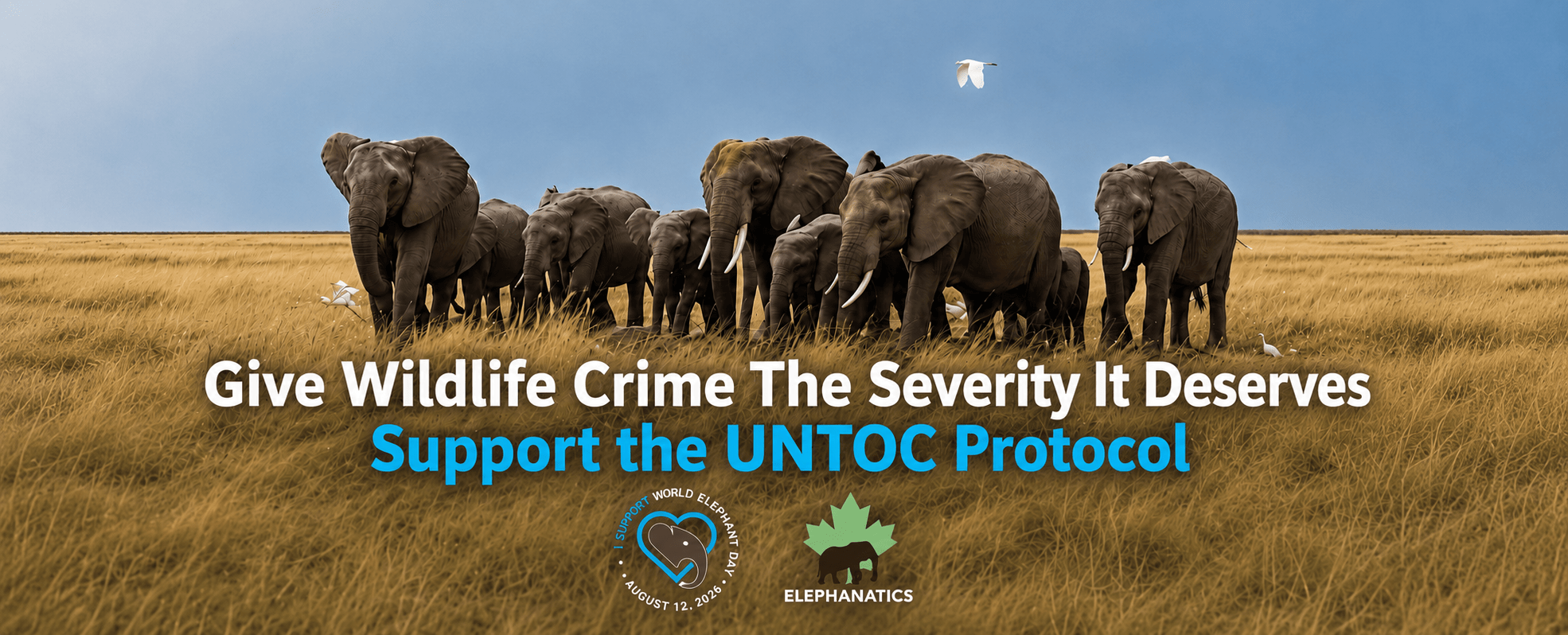
 

🚨 Give Wildlife Crime the Severity It Deserves 🚨

The United Nations Convention against Transnational Organized Crime (UNTOC) is the principal global treaty for fighting international crime networks. Yet, despite transnational wildlife crime generating US$199 billion annually, it remains largely absent from binding global enforcement frameworks. It’s time Canada leads the global effort to establish a dedicated UNTOC Wildlife Crime Protocol and treat trafficking as a serious organized crime.

Click above to open our official UNTOC action letter in a new secure window.


Why Canada Must Act Now

Wildlife crime is no longer just a “poaching” problem—it is a global security threat. 🌎🛡️

Currently, trafficking is often treated as a minor regulatory offense. This allows organized crime syndicates to exploit Canada’s borders with low risk and high reward.

  • The UNTOC Protocol would force a global shift, requiring countries to treat wildlife trafficking with the same legal severity as human or drug trafficking.
  • 🤝 International Cooperation: It would provide law enforcement with better tools for cross-border investigations and intelligence sharing.
  • 📉 Economic Impact: By shutting down a US$199 billion illegal industry, we protect global ecosystems and national economies.

A Powerful Global Collaboration

Elephanatics and World Elephant Day have united to demand real structural change. Both  organizations are dedicated to conservation, education, and advocacy to ensure a safer world for elephants and all threatened species.
Advocating for the UNTOC Protocol is a pivotal moment in our joint mission to alter global law. ⚖️🌿
Currently, existing international agreements cover less than 1% of the world’s species. This leaves millions of animals and plants completely unprotected from heavily armed, highly funded criminal networks.
We cannot do this alone. As we launch this campaign ahead of World Elephant Day, your voice is the most powerful tool we have to ensure Canada leads the way in supporting this vital treaty. 🗣️💪

Thank you for standing with us. Every email sent is a step toward justice.

Take the Mission into the Classroom 🍎📚

Are you an educator or parent? Download our free UNTOC Elephant Education Kit. This comprehensive resource is designed for secondary students to explore the complexities of transnational wildlife crime and the importance of global advocacy. 🏫📖


Unleash the Beast

Uncovering Your Power to Drive Change

by Tessa Vanderkop, VP Elephanatics

If you want to unleash the power of one, you must first look within.

Years ago, I used to speed skate. I started as an adult in my thirties and barely knew how to skate. For many years, I was a part of the children’s group where I was frequently partnered with a teen. Most teens willing to partner with the “old” person in the group were old souls themselves. For a few years, I partnered with Brendon, a tall, lanky, awkward kid of about 14, but somehow we always got on.

I had a natural tendency to hold back, to be very careful, and to never step outside my comfort zone—cautiously navigating the corners like a hundred-year-old lady. Brendon was the exact opposite. He flew around the corners like a windmill, his arms and legs flying as he navigated the tricky ice. Once when I was racing, I could hear him urging me on from the sidelines. “Unleash the Beast!” he urged. “Unleash the Beast.”

I will never forget that. I was never able to quite unleash the beast while skating. However, when I discovered my passion for elephants, I finally found my true calling. I learned to take my passion and my skills to unleash the power of one, step outside my comfort zone, advocate on their behalf, and find my community of changemakers.

When I have spoken to other advocates, I often hear a similar story that goes like this:

1) You uncover an issue or a problem that you feel driven to change. It is often a seemingly insurmountable problem, but you wake up every morning thinking what can I do today to help move this forward. What is within my “hug zone” to drive change?

2) Every one of us has unique strengths. What are yours? Are you a great writer? Are you a social media whizz? Are you an organizer? Do you have expertise in a certain area? One of our greatest strengths collectively is our network of family, friends, work mates, school mates.

3) Your purpose is the intersection between your passion and your unique strengths and the social or environmental issue you want to solve.

So how do you unleash the power of one?

Unleash the Power of One Toolkit

Step 1: What moves you?

We don’t usually choose the issues we care most about—they choose us.
Reflect on the moments, experiences and injustices that stay with you and ask yourself:

· What issue do I keep coming back to, even when no one is asking me to?

· What makes me angry, hopeful, or deeply curious?

· What problem would I happily spend years helping to solve?

· When have I felt, “Someone should do something about this”…. and realized maybe I am someone?

· If I could improve one thing for future generations, what would it be?

· What is inside my “hug zone”—the change I can realistically influence?

Reflection: What change do you want to help create in the world?

Step 2: What do you bring?

Everyone has assets that can help create change. Some people communicate. Some organize. Some connect people. Some raise money. Some build ideas. Some influence policy. Some simply know how to bring others together.

Consider:

Skills

· What do people naturally come to me for?

· What am I good at?

· What skills have I developed through work, volunteering or life?

Relationships

· Who do I know?

· What communities am I already part of?

· Who trusts me?

Experience

· What lived experience gives me insight others may not have?

· What challenges have shaped who I am?

Personal Strengths

· What comes naturally to me?

· When do I feel most energized?

· What kinds of contributions make me lose track of time?

Reflection: What unique combination of strengths could I contribute?

Step 3: Where do they intersect?

Purpose lives where your passion meets your strengths.

Ask:

· How could my strengths help move this issue forward?

· What role feels authentic to me?

· What contribution could I make consistently over time?

· What first step feels exciting rather than overwhelming?

Reflection: What is my unique contribution?

Step 4: Find Your People

No one changes the world alone. Every movement begins with people finding one another.

Ask:

· Who is already working on this issue?

· Who inspires me?

· Where are people gathering around this cause?

· Who could I learn from?

· Who might benefit from my skills?

Reflection: Who could I collaborate with?

Step 5: Start Small. Stay Consistent.

Change rarely begins with one giant leap. It begins with one conversation. One introduction. One article. One volunteer opportunity. One act of leadership.

Ask yourself each morning:

· What is one thing I can do today that is within my influence?

· Who can I encourage?

· What conversation needs to happen?

· What small action moves this issue one step forward?

Meaningful change is created by thousands of small actions, taken consistently, by ordinary people who decide to use their unique strengths for something that matters. While I wasn’t able to unleash my beast as a speedskater I am forever thankful to Brendon for showing me that passion can drive change. It look me a few years to find an issue that was very deep in my heart, but when I did, I was able to harness my power for change!

International Day for Biological Diversity

The Value of Nature: How Real-Time Data is Unlocking the Future of Biodiversity

Following yesterday’s International Day for Biological Diversity, we are keeping the momentum going by reflecting on a massive paradigm shift currently underway in how the world calculates wealth. For decades, the global economy has treated nature as an infinite, free resource. We calculated the economic value of a forest by the price of its timber, and the value of an ecosystem by the land cleared for development.

But conservationists and forward-thinking economists are asking a fundamental question: What if we structurally value a living, breathing ecosystem more than a destroyed one?

In a recent, high-profile feature by Fortune, our director, Dr. JakeWall, CEO Wildlife Dynamics, pulled back the curtain on how advanced technology is turning this concept into a reality. By leveraging EarthRanger—a revolutionary data platform utilizing real-time visualization and predictive AI tracking—we aren’t just protecting wildlife on the ground; we are building the financial foundation needed to fund global conservation forever.

Moving From “Reactive” to “Proactive” Protection

At its core, EarthRanger acts as the central nervous system for vast, vulnerable landscapes. It integrates data from satellite collars, ranger patrol radios, camera traps, and weather monitors into a single, live map.

As the Fortune piece highlights, this allows field teams to shift from a reactive state (discovering a poaching incident after it occurs) to a proactive state. If an elephant stops moving unexpectedly, or if an asset behaves abnormally, the AI flags it instantly. It coordinates frontline rangers, mitigates human-wildlife conflict before it impacts local communities, and keeps wildlife safe.

EarthRanger and Biodiversity Credit Markets

You have likely heard of carbon credits, but biodiversity credit markets are the next frontier. Under this framework, companies, governments, and philanthropists invest directly in the preservation of specific habitats.

The catch? Investors want proof. They need to know that if they fund a square kilometer of African savannah, that ecosystem is actually staying intact; that the elephant populations are thriving, and the biodiversity is being protected.

But having this mountain of precise, undeniable data does something even more profound. It solves the biggest obstacle holding back global funding for conservation: providing absolute proof to investors that their money is actually saving wildlife!

Because EarthRanger tracks landscape data continuously, it provides the transparent, up-to-date verification that financial markets require. We can now prove, with definitive data, that a protected area is being managed effectively.

Nature = Value

As Jake perfectly summarized in his interview, long-term wildlife protection requires a fundamental rewrite of how global financial markets perceive the natural world.

“If you can’t value it, you can’t protect it. We have to change the macroeconomics so that nature equals value.” > — Dr. Jake Wall, Fortune

When we give global markets a verifiable, data-backed mechanism to invest in living nature, protecting an elephant or a pristine migratory corridor ceases to be a charitable expense—it becomes a measurable, protected, and valuable asset to the world.

The Path Forward

Integrating cutting-edge data science with on-the-ground enforcement isn’t just a tech upgrade—it is an absolute necessity for the future of landscape rewilding and species protection. We are incredibly proud of Jake and the entire EarthRanger team for earning this well-deserved global recognition on the pages of Fortune.

As a community, your support allows us to champion these frontrunner technologies. The future of conservation isn’t just about fighting to stop the loss; it’s about building a world where a thriving planet is recognized as our most valuable asset.

*** 👉 Click Here to Read the Full Fortune Magazine Feature

Donate

Fran Duthie > President and Co-founder, Elephanatics

#EarthDay2026

An Economy for Elephants: Thriving in a Biodiverse World

By Tessa Vanderkop, Director of Elephanatics

Elephanatics Foundation - Free elephant conservation lesson plans, toolkits for teachers, and persuasive essay resources.

On this Earth Day, I find myself looking back at a time when the state of our world—and the slow elimination of elephants—felt like a reason only for tears. For years, I held a deep love for these intelligent, social, and ecologically vital beings, yet the problem always felt too vast for one person to change.

The statistics are horrifying and by now well known.  Every 15 minutes an elephant is poached for its ivory (15,000 to 20,000 annually). The precipitous population decline from approximately 1.3 million in 1970s to 350,000 today puts them at risk of extinction within the our generation.

When the team at Elephanatics and I co-led the Ivory-Free-Canada campaign, it took years of collective effort to tighten Canada’s outdated ivory regulations. That dedication paid off in November 2023 when the government announced historic amendments to the Wild Animal and Plant Trade Regulations (WAPTR). Enacted on January 8, 2024, these new laws effectively closed Canada’s borders to the import and export of raw ivory and rhino horn, and finally banned the importation of hunting trophies.

It was a meaningful victory, but a sobering one.

Because these kinds of wins,  as important as they are, remain fundamentally insufficient in the face of a much larger crisis.

A landmark 2019 report from the United Nations found that over one million species are now at risk of extinction. Human activity has altered 75% of terrestrial environments and 40% of marine ecosystems. We are degrading soils, polluting waterways, and pushing critical systems toward collapse. In the past two decades alone, half of the world’s coral reefs have been lost.

Elephants are not disappearing in isolation. They are part of a much broader unraveling with scientists warning that we’re approaching a tipping point toward potential collapse.

When we look closely at the threats facing elephants, poaching, habitat loss, human-wildlife conflict, and fragmentation, we begin to see that something much larger is happening. They are symptoms of the same underlying system: an economy built on extraction.

The very nature of our economy is based on extractive practices, known as the “take, make, waste” capital economy that focusses on profit as the key indicator of success.   If we take elephants as an example, the quadruple threats of biodiversity loss, human wildlife conflict, habitat fragmentation and poaching we can see more clearly that the economic system that we created serves the profit goals primarily of shareholders and boards and not the greater good of people and planet. The very resources that fuel this economy are limited and this shortsightedness has left us in a mess of our own making.

A redesign of our economic system is desperately required. Economic systems are created by humans and can be reengineered to align with the well-being of all.  The good news is the “well-being” or “purpose” economy is already well underway.

A purpose economy is an economy powered by the pursuit of long-term well-being for all in which business and regulatory and financial systems foster an equitable, flourishing, resilient future.

The Canadian Purpose Economy Project was founded for exactly this reason. As we work with adjacent movements in the circular economy, clean energy transition and the wellbeing economy we can see the offramp to the   legacy economic system (current system)  that has fueled the climate and biodiversity crisis, fostered inequality, war and global instability.

Can we staunch the bleeding before it’s too late? The work that so many do to enact measures and regulations will and can help. But it won’t change the flawed foundations on which we have built the modern economy. The work I do in the purpose economy is fueled by my passion to save the world’s elephants. Let’s re-imagine an economic system where humans, our beautiful planet and yes, elephants can thrive for now and future generations

People driving change are ordinary everyday people finding something they’re passionate about and deciding to take small extraordinary steps every day to try to make a difference.

It often starts by recognizing what you are incredibly passionate about, and understanding what your unique strengths are to help advance your cause.

What are your strengths and what moves you to make the world a better place?

Happy World Wildlife Day 2026

The Gardeners of the Global Pharmacy: Elephants, TCM, and World Wildlife Day 2026

Happy World Wildlife Day! 🌍🐘

Today, March 3rd, we join the global community in celebrating #WWD2026. This year’s theme, “Medicinal and Aromatic Plants,” highlights a delicate balance between human health and the survival of the species that maintain our natural “pharmacies.” At Elephanatics, we’ve always called elephants the “Master Gardeners” of the wild. But as we celebrate their role in planting the world’s healing herbs, we must also address the darker reality of how “medicine” is still being used as a justification for their destruction.

The Black Market Reality

While many are aware of the ivory crisis, a persistent and devastating threat remains: the use of elephant skin and other parts in Traditional Chinese Medicine (TCM). Despite stricter laws passed in recent years and a growing global outcry, a shadow “black market” continues to thrive.

Wildlife products—including those from endangered elephants—are still being trafficked to treat various ailments, often bypassing legal protections entirely. While Elephanatics has focused heavily on education and habitat protection in recent years, we remain vigilant advocates against any trade that values an animal’s body parts over its life. The fight to move global medicine toward a truly wildlife-free future is far from over.

The Solution: Supporting the “Wild Greenhouse”

There is a bitter irony in this trade: elephants are the primary reason many medicinal plants exist at all. They are “Zoo-pharmacognosists”—natural doctors who seek out specific barks and roots to heal themselves.

By dispersing seeds through their dung and clearing forest paths, elephants cultivate the very herbs that should be the focus of traditional healing.

This is the dialogue we must advance: We need to support the transition within the TCM community away from animal parts and toward the sustainable, plant-based alternatives that elephants help grow. By protecting the ‘Master Gardeners,’ we aren’t just saving a species; we are protecting the natural laboratory that produces the sustainable medicines of the future. We are also protecting ourselves from the emergence of new health crises linked to the wildlife trade.

How You Can Be a “Habitat Hero” Today

We may not be able to stop the black market overnight, but we can influence the demand through education and awareness. This World Wildlife Day, help us advocate for a world where health doesn’t come at the cost of a herd:

  1. Educate the Next Generation: If you are a teacher, use our rewilding lesson plan to show students how protecting biodiversity globally protects the plants we all rely on.

  2. Stay Informed: Awareness is our greatest tool against the illegal trade. Share this post to help others understand the link between conservation and sustainable medicine.

  3. Support the “Gardeners”: Your support helps fund our ongoing mission to ensure the long-term survival and protection of African elephants in the wild. Donate 

By protecting the “Master Gardeners” of the wild, we ensure the survival of the entire ecosystem they sustain. Let’s continue to work together to protect the future of the herd!

The Elephanatics Team  🌍🐘

2025: A Year of Victory and Hope

"Elephanatics Foundation - Free elephant conservation lesson plans, toolkits for teachers, and persuasive essay resources."2025 Year in Review

As we reach the final days of the year, the team at Elephanatics is reflecting on its major milestones in elephant conservation for 2025. From the high-stakes policy tables in Uzbekistan to the vibrant ecosystems of the Mara, your support has fuelled a year of  progress, crucial advocacy, and a brighter future for elephants.

Honouring Conservation Excellence

We are incredibly proud to celebrate the achievements of our team members who are leading the way in science and conservation. This year, we celebrate Dr Jake Wall for receiving the prestigious Esmond B. Martin Royal Geographic Society Prize: Awarded for outstanding individual achievement in geographical research and its application to wildlife conservation.

Additionally, our Director, Dr René Beyers, led the official publication of the IUCN Rewilding Guidelines at the World Conservation Congress, setting a new global standard for ethical, science-based conservation policy.

A Voice for Elephants: CITES-CoP20 Update

We are relieved that the international ban on ivory sales remains in place. Proposals to reopen the trade and sell off ivory stockpiles were successfully blocked—a major win for elephant safety.

However, other decisions have created new risks. Changes were made that now allow for:

  • Commercial Sale of Parts: A legal path for the sale of elephant skins, hair, and leather.

  • Live Elephant Exports: Loosened rules that make it easier to send wild elephants to zoos and captive facilities far from their natural homes.

Why this matters: Allowing any part of an elephant to be sold for profit creates “commercial loopholes” that can be used to hide illegal poaching. It treats these magnificent animals as products rather than a protected species.

This is exactly why we need a new global treaty—an additional Protocol to the UNTOC (UN Convention against Transnational Organized Crime). We must close these doors for good and treat wildlife crime as the serious international organized crime it truly is.

Empowering the Next Generation: Education

Fostering a deep understanding of elephants is the cornerstone of our mission. This year, we expanded our reach by launching new educational lesson plans tailored for both elementary and secondary educators. These resources, designed for Canadian and US curriculums, help students explore elephant ecology, the importance of keystone species, and global conservation challenges.

Educators: You can explore and download our full range of updated lesson plans at elephanatics.org/education.

Investing in Local Leadership: 2025 Scholarship Recipients

Our commitment to on-the-ground conservation remains a core pillar of our mission, primarily through the Fran Duthie African Elephant Conservation Scholarship. Administered in partnership with the Mara Elephant Project (MEP), this scholarship is designed to cultivate the conservation leaders of tomorrow.

To date, we are incredibly proud to have supported many students as they pursue higher education in fields vital to the survival of the African elephant. By providing this scholarship, we are doing more than just paying tuition; we are investing in a sustainable future for the Greater Mara ecosystem.

The Impact of the Scholarship

By removing financial barriers, this grant empowers local students to:

  • Gain Specialized Expertise: Pursuing degrees in Forestry, Environmental Science, and Climate Advocacy to bring scientific solutions to their communities.

  • Bridge the Gap: Serving as a vital link between traditional livelihoods and modern biodiversity protection.

  • Lead Local Outreach: Becoming advocates who inspire their neighbors to value and protect the “gardeners of the forest.”

  • Secure Conservation Careers: Creating a pathway for those living closest to elephants to become the professionals leading the charge to save them.

Frontline Success

Together, we surpassed our World Elephant Day fundraising goal for the Mara Elephant Project, helping protect high-value acres of the Loita Forest in Kenya—a vital sanctuary for elephants and rare biodiversity.

In Remembrance of Our Heroes

As we look toward the future, we pause in sad remembrance of the visionary conservationists we lost this year: Dr. Jane Goodall and Dr. Iain Douglas-Hamilton. Their tireless advocacy, groundbreaking research, and profound love for wildlife changed the world forever. While we mourn their passing, we find strength in their example; their legacy and love for wildlife will live on through the work we continue to do every day.

Thank you for being a vital partner in our fight to secure a safer future for elephants and all wildlife. We wish you a happy and healthy New Year filled with hope and success!

The Elephanatics Team

Happy Holidays from Elephanatics!

"Elephanatics Foundation - Free elephant conservation lesson plans, toolkits for teachers, and persuasive essay resources."

Happy Holidays from Elephanatics 2025!

“Winter’s chill has cast its spell on festive nights we know so well,
as shadows of our past reflect the days of old we can’t forget.
Where elephants roam we stand to shield the ancient grace their spirits yield,
we vow to guard their grand design, and end the harm from all mankind.
While moonlight shares its hypnotic glow between the trees that whisper joy,
rejoice, reclaim, and start anew— the season’s magic is here for you!” 

We thank you for your continued support and wish you all the very best for the season and new year ahead.

The Elephanatics Team