
“Elephants are not human, of course. They are something much more ancient and primordial, living on a different plane of existence. Long before we arrived on the scene, they worked out a way of being in the world that has not fundamentally changed and is sustainable, and not predatory or destructive.” Alex Shoumatoff
One might question why humanity continues to be a formidable and increasingly detrimental threat to nature, while nature continues to be the only hope left for our survival. The phrase, ‘cut off your nose to spite your face,’ comes to mind.
Undeniably, humankind has never fathomed the nuances required to sustain a viable and healthy world, but rather has created an ecological and environmental conundrum that will be the demise of our species and many other species, unless immediate action is taken to reverse this deleterious trend. Elephants and many other wildlife species are becoming extinct from the increased threat of habitat loss and the illegal wildlife trade mainly due to humanity’s ignorance.
In March 2022, the Canadian government mandated to end the elephant ivory and rhinoceros horn trade and work with partners to curb the illegal wildlife trade in Canada. We are still waiting for action to be taken on this initiative. The following information reaffirms the necessity to get this mandate done as soon as possible:
In a report by the International Monetary Fund (IMF) Finance and Development department, the carbon value of a single forest elephant is worth $1.75 million dollars. Elephants help mitigate climate change by maintaining forest and savannah ecosystems for other species and are integrally tied to rich biodiversity.
In a study done by Yale school of the Environment on climate change, Professor Oswald J. Schmitz states, “Wildlife species, throughout their interaction with the environment, are the missing link between biodiversity and climate. This interaction means rewilding can be among the best nature-based climate solutions available to humankind.”
The data in this study showed that protecting or restoring wildlife populations could collectively facilitate the additional capture of 6.41 billion tons of carbon dioxide annually. This is 95% of the amount needed every year to meet the Paris Agreement target of removing enough carbon from the atmosphere to keep global warming below the 1.5-degree Celsius threshold. The health of our planet is ultimately dependent on healthy biodiversity and ecosystems globally.
To be certain, the elephant ivory trade dates back to the 14th century. During the colonization of Africa, approximately 800 to 1,000 tonnes of ivory was sent to Europe every year to be used for making piano keys, billiard balls, and other usages. By the 1970’s Japan consumed approximately 40% of the global trade and another 40% was consumed by Europe and North America.
Fast forward to today and China has become the largest consumer of ivory products in the world where the vast majority of smuggled ivory—experts say as much as 70 percent—ends up. With increased economic growth, a wealthy Chinese middle class has fuelled the demand for luxury ivory products and although seizures of illegally obtained ivory take place, much of the smuggled ivory still gets through. The Convention on International Trade of Endangered Species (CITES) reports that nearly all the current demand for elephant ivory comes from the Chinese market.
In March of 2021, the African forest elephant, Loxodonta cyclotis, was listed as critically endangered and the African savanna elephant, Loxodonta africana, as endangered on the International Union for Conservation of Nature (IUCN) Red List of Threatened Species. The causes are identified as poaching for ivory in the short term and habitat loss in the longer term. The number of African forest elephants fell by more than 86% over a period of 31 years, while the population of African savanna elephants decreased by at least 60% over the last 50 years. The Red List continues to classify the Asian elephant as endangered with as little as 52,000 left in the wild.
According to an IUCN Report, approximately 111,000 elephants were lost between 2006-2015 leaving an estimated 415,500. In the last forty years, elephant habitat has decreased by nearly two thirds largely due to human activities.
A paper led by the Mara Elephant Project’s Director of Research and Conservation Dr Jake Wall, discovered that human activity largely shapes the behaviour and distribution of modern elephants. 62% of Africa has suitable habitat for elephants, but the animals use just 17% of that habitat and are absent – for now – in the remaining 83%.
Along with poaching, the demand for rhino horn is highly sought after for Traditional Chinese Medicine use. The trade of TCM using body parts of IUCN red-listed animals must be regulated. Additionally, new research by Vincent Nijman, Professor in Anthropology at Oxford Brookes University states, “With three out of four newly emerging infectious human diseases originating in animals, there is an urgent need to monitor the legal trade in wildlife… given that in many instances the legal wildlife trade is several orders of magnitude larger than the illegal trade, it is ineffective and possibly dangerous to focus on the illegal wildlife trade only.” Pandemics will continue as long as the legal trade in wildlife goes unabated.
Consequently, wildlife trafficking has quickly become a multi-billion-dollar transnational criminal activity that is not only a conservation issue but also a security threat. It is ranked as the fourth most profitable transnational crime, only behind the drug trade, arms trade and human trafficking. During the pandemic, there was a significant shift toward online sales of ivory, particularly on eBay and social media.
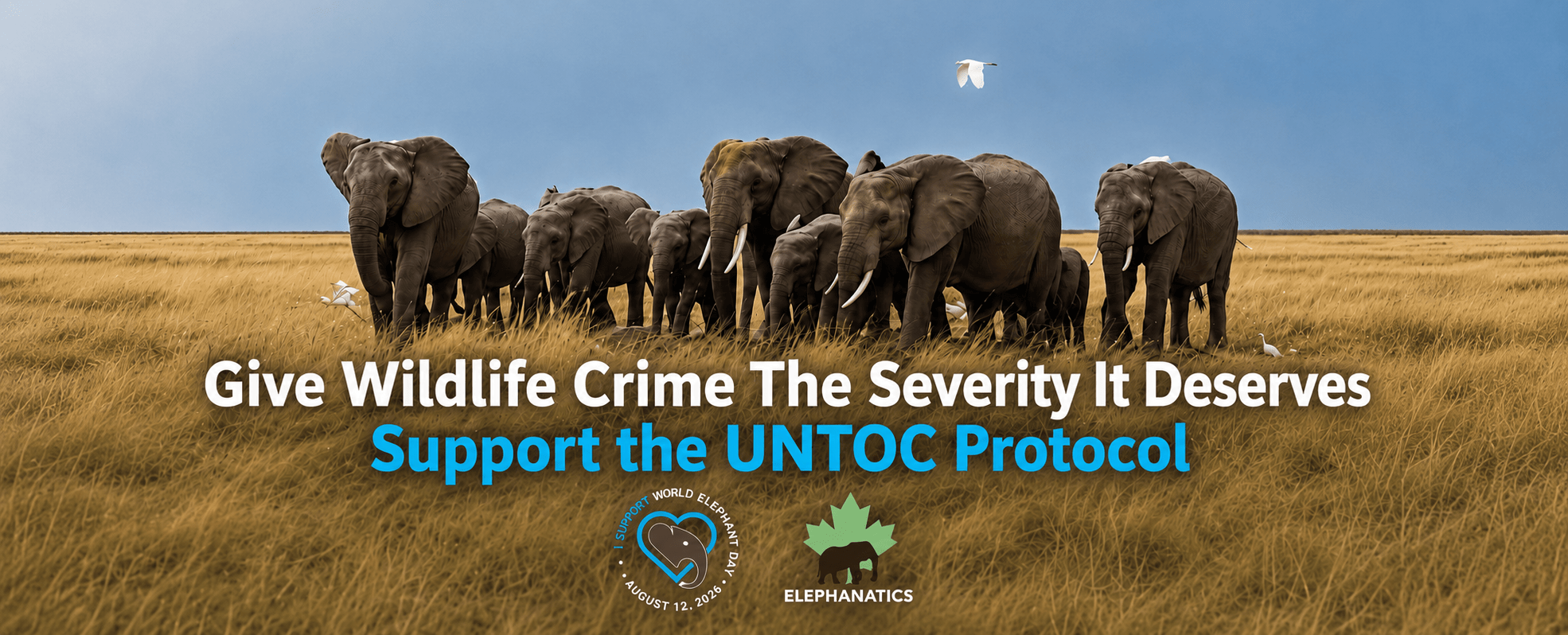
In May of 2022 the UN moved closer towards tackling the illegal wildlife trade. The UN Commission on Crime Prevention and Criminal Justice (CCPCJ) adopted an historic resolution. Angola, Kenya, and Peru submitted the draft resolution in April. It was titled ‘Strengthening the international legal framework for international cooperation to prevent and combat illicit trafficking in wildlife.’ It called on the UN Office on Drugs and Crime (UNODC) to consider the benefits of adopting an additional protocol in the UN Convention against Transnational Organized Crime (UNTOC).
This additional protocol would be specifically about preventing and combating the illegal wildlife trade. Current protocols in UNTOC cover the trafficking and smuggling of people, and the manufacturing and trafficking of arms. This is a step in the right direction!
Furthermore, in February of 2023, a new public-private partnership, targeting the global black market in wild animals and their body parts, was initiated by Scotiabank and FINTRAC, which encourages information sharing between financial institutions, conservation groups, and financial intelligence units in Canada, South Africa, Australia, the U.K and elsewhere. This is a huge initiative and targets the middlemen responsible for illicit wildlife trafficking.
Money laundering plays a significant role in the illegal wildlife trade with criminals looking for an easy way to move whatever commodity they can to make a profit. Sam Cooper, Canadian investigative journalist and founder of The Bureau says that international law enforcement have identified networks of hunting junket operators in Canada, Latin America, Africa and Australia, intertwined with fentanyl traffickers and Chinese state actors. Cooper said illegal wildlife hunting and trafficking facilitate laundering of drug cash and movement of narcotics for gang bosses, but junket operators also use illegal big game hunting as a social networking tool, gathering gangsters, corrupt officials, and state actors. “Vice and profit go hand-in-hand in these international crime and corruption networks,” Cooper said.
While strong law enforcement initiatives are imperative to curb the illegal wildlife trade, the fact remains that habitat loss, poaching, human-elephant conflict, trophy hunting, and the legal ivory trade are still enormous threats contributing to elephant population declines and their survival.
We continue to encourage the Canadian government to follow through with its mandate as a matter of urgency and we ask that you do the same.
Please Take Action to make sure the government fulfills its obligation and stops stalling on its commitments.
“In the end … success or failure will come down to an ethical decision, one on which those now living will be judged for generations to come.” Edward O. Wilson
Fran Duthie
President / Co-Founder
Elephanatics

 Empowering Tomorrow’s Change-Makers Today 🍁🐘

