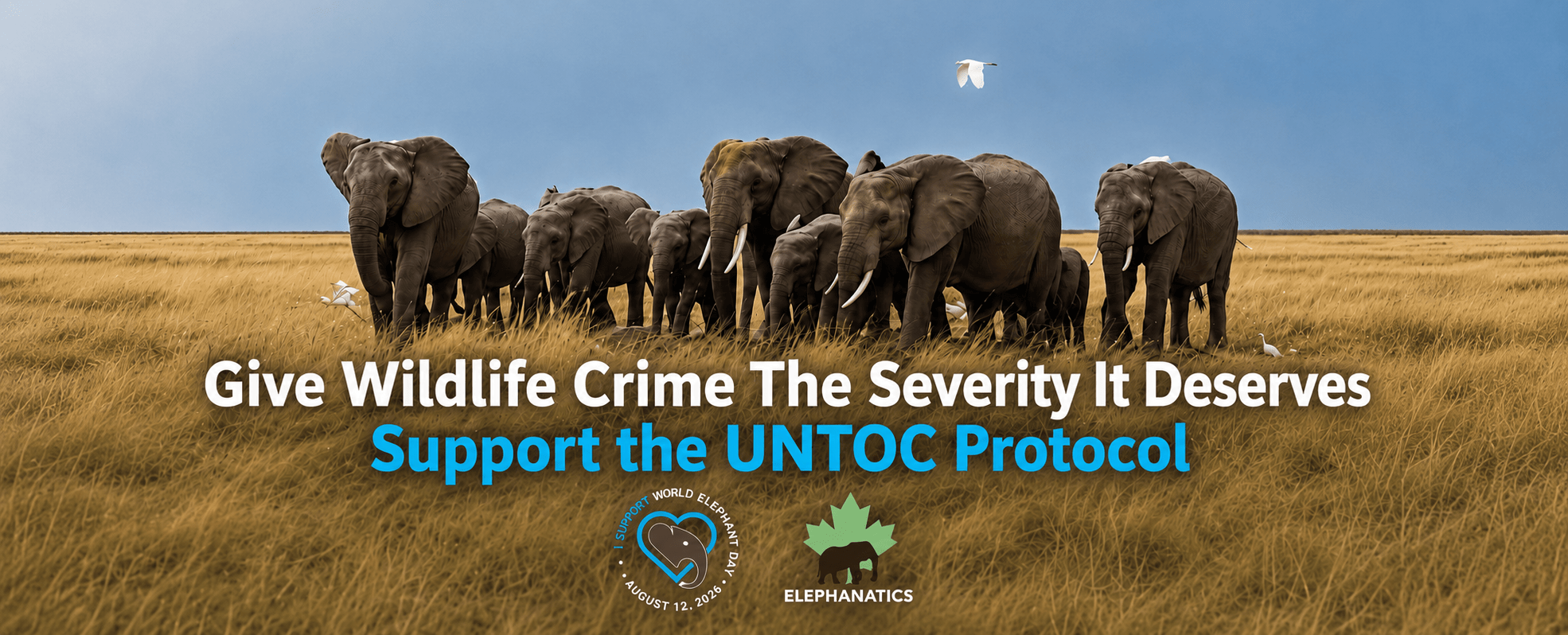
When you look into the eyes of a wild elephant, you get an overwhelming sense of your own humility. During a trip to Kenya’s Maasai Mara, a matriarch charged our jeep, stopping just three feet away. In that heart-stopping moment, our eyes met—a stark reminder that we are in their world, and the only way to truly protect nature and wildlife is to listen to it.
Today, that protection is failing on a global scale. Transnational crime syndicates generate $199 billion annually through illegal wildlife trafficking—often operating through the same organized networks that smuggle weapons, illicit drugs, and human beings, taking advantage of weak laws and low penalties.
Elephanatics and World Elephant Day have collaborated to rally Canadians to demand our government support a binding Wildlife Crime Protocol under the United Nations Convention against Transnational Organized Crime (UNTOC). With crucial discussions unfolding at the UN Commission on Crime Prevention and Criminal Justice (CCPCJ) this September and leading directly into the 13th Conference of the Parties (COP13) in Vienna this October, your local Member of Parliament needs to hear from you today.
(Your letter is automatically formatted and sent directly to your local Member of Parliament based on your postal code.)
Why We Need Action Ahead of CCPCJ & UNTOC COP13
Today, transnational wildlife trafficking is a multi-billion-dollar criminal enterprise. Poachers and organized syndicates exploit legal loopholes across borders, pushing vulnerable species toward extinction worldwide because international law continues to treat wildlife crime as a minor offense.
After an eight-year campaign, Elephanatics successfully helped push through strict new regulations to end Canada’s trade in elephant ivory and rhino horn in 2024. Now, we must finish the job on the global stage.
A legally binding UNTOC Protocol will:
Close Legal Loopholes: Harmonize global laws so traffickers cannot hide behind weak borders.
Target Syndicates: Give law enforcement cross-border intelligence tools to freeze cartel assets.
Impose Severe Penalties: Treat wildlife crime with the exact same legal severity as human, arms, and drug trafficking.
Stand With Us Before the Fall UN Summits
I will never forget the moment nature challenged me to respect its voice. Now, decision-makers in Ottawa need to hear yours.
As students across British Columbia return to the classroom this September, Elephanatics, in partnership with World Elephant Day, is launching our most crucial educational initiative yet: the Wildlife Crime Civic Action Student Toolkit.
Wildlife trafficking is one of the most lucrative transnational crimes in the world, threatening keystone species like African elephants and destabilizing fragile ecosystems. Real change requires systemic international policy—and our youth have a vital role to play in driving that conversation.
Why This Matters to Every Single One of Us 🌍
It is easy to view wildlife trafficking strictly as an animal welfare issue, but wildlife crime is environmental crime. Elephants and other keystone species are the vital pillars holding entire ecosystems together—ecosystems that produce our clean air, store carbon, maintain soil health, and protect global water cycles.
When criminal syndicates strip ecosystems of their natural biodiversity, they accelerate ecological collapse, increase human exposure to zoonotic diseases, and threaten local communities dependent on natural resources. Fighting for a global UNTOC Wildlife Crime Protocol isn’t just about protecting iconic species; it is about defending the natural systems that sustain human life and safeguarding our shared planet against organized environmental destruction.
A Free, Hands-On Resource for Secondary Classrooms 📚
Designed for Grades 6–12 Science, Social Studies, and English Language Arts, this interdisciplinary resource connects classroom learning directly with real-world civic engagement.
Through engaging modules, students will explore:
🌾 Environmental Crime & Ecosystems: How transnational wildlife trafficking destabilizes global ecosystems, economic security, and public health.
🌐 Organized Crime Syndicates: How multi-billion-dollar criminal networks exploit legal gaps across international borders.
✍️ Civic Action & Democracy: The power of democratic participation through targeted advocacy letter-writing to Canadian government leaders.
Why the Timing Matters ⏳
This October, world leaders are gathering for a major global summit on international organized crime. Ahead of this critical summit, Canadian students have a unique window of opportunity to make their voices heard by writing directly to decision-makers and Members of Parliament, advocating for stronger global laws to shut down wildlife trafficking networks.
How You Can Help Drive Immediate Impact 🚀
Whether you are an educator, parent, or supporter, here is how you can help us reach classrooms this fall:
📣 Share the Toolkit with Teachers: Pass our free curriculum package along to secondary educators, science coordinators, or school principals in your community.
📥 Download the Materials: Explore the lesson plan and letter-writing guides directly on our website.
🌐 Spread the Word: Share our campaign link on social media to build momentum.
The United Nations Convention against Transnational Organized Crime (UNTOC) is the principal global treaty for fighting international crime networks. Yet, despite transnational wildlife crime generating US$199 billion annually, it remains largely absent from binding global enforcement frameworks. It’s time Canada leads the global effort to establish a dedicated UNTOC Wildlife Crime Protocol and treat trafficking as a serious organized crime.
Click above to open our official UNTOC action letter in a new secure window.
Why Canada Must Act Now
Wildlife crime is no longer just a “poaching” problem—it is a global security threat. 🌎🛡️
Currently, trafficking is often treated as a minor regulatory offense. This allows organized crime syndicates to exploit Canada’s borders with low risk and high reward.
The UNTOC Protocol would force a global shift, requiring countries to treat wildlife trafficking with the same legal severity as human or drug trafficking.
🤝 International Cooperation: It would provide law enforcement with better tools for cross-border investigations and intelligence sharing.
📉 Economic Impact: By shutting down a US$199 billion illegal industry, we protect global ecosystems and national economies.
A Powerful Global Collaboration
Elephanatics and World Elephant Day have united to demand real structural change. Both organizations are dedicated to conservation, education, and advocacy to ensure a safer world for elephants and all threatened species.
Advocating for the UNTOC Protocol is a pivotal moment in our joint mission to alter global law. ⚖️🌿
Currently, existing international agreements cover less than 1% of the world’s species. This leaves millions of animals and plants completely unprotected from heavily armed, highly funded criminal networks.
We cannot do this alone. As we launch this campaign ahead of World Elephant Day, your voice is the most powerful tool we have to ensure Canada leads the way in supporting this vital treaty. 🗣️💪
Thank you for standing with us. Every email sent is a step toward justice.
Take the Mission into the Classroom 🍎📚
Are you an educator or parent? Download our free UNTOC Elephant Education Kit. This comprehensive resource is designed for secondary students to explore the complexities of transnational wildlife crime and the importance of global advocacy. 🏫📖
At Elephanatics Foundation, we’re committed to educating the next generation. We believe that fostering a deep understanding of elephants—their vital role as a keystone species and their status as iconic mammals crucial to local and global ecosystems—is the cornerstone for building the next generation of future conservationists.
Elephanatics Education Resources for Teachers | Educators | Homeschools
To better support teachers and students, we have created new, updated, and personalized lesson plans tailored for elementary and secondary educators. Access our full range of elementary and intermediary lesson plans, designed for both Canadian and US curriculums, with a simple click! Available below for immediate download:
For elementary and secondary school educators – bring a wildlife ranger or elephant researcher into your classroom! To find out more clickhere.
Check out our lesson plans on elephant ecology and action! Click here to learn more.
NEW! Request a teacher to do a virtual presentation in your classroom! Pick a special day like #WorldElephantDay #WorldWildlifeDay or #EarthDay to make it even more impactful! Or, just pick any day that suits you!
On behalf of the Fran Duthie(Elephanatics) African Elephant Conservation Scholarship, Mara Elephant Project is thrilled to welcome four incredible young conservation champions into the herd! These four candidates were chosen not only for their passion and drive, but also because they represent the communities Mara Elephant Project partners with to protect wildlife and their habitats. Amos and Faith are from the Loita area and are passionate about its preservation. Additionally, Sarah and Robert are from key operational areas in the Mara where the community is critical to supporting MEP’s coexistence efforts. Together, they represent the future of conservation, leaders driven by resilience, passion, and a vision for thriving communities and wild spaces. Congratulations, Faith Leuka, Amos Baari, Robert Muli and Sarah Loiman!
Read more about their journeys here.
A huge, heartfelt thank you to everyone who joined us in celebrating #WorldElephantDay with a donation! This year, Elephanatics was honored to partner with the Mara Elephant Project (MEP), an organization on the front lines of elephant conservation in Kenya, Africa. Our shared goal was to raise awareness and critical funds for the Loita Forest in Kenya, a lush and biodiverse habitat that is not only home to a thriving elephant population but also a sanctuary for many other rare and endangered species. Our initial target was to raise $1,200, and we are beyond grateful to share that with a generous dollar-for-dollar match from Elephanatics, we completely surpassed that goal! Your contributions will directly fund the Mara Elephant Project’s crucial on-the-ground efforts—from anti-poaching patrols that keep elephants safe, to community-led programs that resolve human-wildlife conflicts. Every dollar donated will be put to work immediately, ensuring the guardians of this forest have the resources they need to protect this precious ecosystem. Thank you for being an essential part of the solution where together we are helping to protect and build a world where elephants and all wildlife can thrive.
Conservation and Technology
Can Tech Turn the Tide on Wildlife Crime?
As one of the world’s most profitable international crimes, the illicit wildlife trade generates billions in revenue each year. The criminal syndicates responsible for poaching and illegal resource extraction are highly organized and well-funded. Find out how scalable innovation is being used as a strategic tool to effectively counter this global threat. Read morehere.
Interested in supporting our work? Click here to donate.
Canadian organizations are calling on #Canada this World Wildlife Day to fulfill its obligations from #CITES routine decisions made in 2022 that protect over 500 endangered species.
After two years since the last Convention on International Trade in Endangered Species (CITES), Canada is the only country out of 185 parties that has not updated its control list of endangered species making Canada an open conduit for trafficking in these species.
The sixteenth meeting of the Conference of the Parties (COP16) to the Convention on Biological Diversity (CBD) is taking place in Cali in Columbia, from 21 October to 1 November 2024. Canada’s Kunming-Montreal Declaration aims to set ambitious goals to halt the loss of biodiversity, promote sustainable development, and enhance global environment efforts by 2030. Elephanatics has written letters and sent emails to the Ministers of Environment and Climate Change and MP’s across Canada asking that they support the merits of a global agreement in the form of an additional protocol to the United Nations Convention against Transnational Crime (UNTOC) to strengthen the international legal framework to tackle illegal wildlife trade. Because the illegal wildlife trade is so interconnected with biodiversity loss, a global agreement is the next logical step to take.
We hope you consider writing your MP to support our ask. Find a pre-written letter here (featured Item)
Find your MP here
See our communication below:
……………………..
The Honourable Steven Guilbeault, P.C., M.P., Minister of Environment and Climate Change, House of Commons, Ottawa, ON K1A 0A6
via email: Steven.Guilbeault@parl.gc.ca
cc:
Hon. Mélanie Joly, P.C., M.P., Minister of Foreign Affairs melanie.joly@parl.gc.ca
Hon. Arif Virani, P.C., M.P., Minister of Justice and Attorney General of Canada arif.virani@parl.gc.ca
September 18, 2024
Dear Minister Guilbeault,
Please see attached letter sent to you March 7, 2024, in reference to strengthening the international legal framework to tackle the illegal wildlife trade by considering the merits of a global agreement in the form of an additional protocol to the United Nations Convention against Transnational Crime (UNTOC). Despite the scale and impact of IWT – one of the largest illegal markets in the world – a global agreement covering this topic still does not exist.
The sixteenth meeting of the Conference of the Parties (COP16) to the Convention on Biological Diversity (CBD) is taking place in Cali in Columbia, from 21 October to 1 November 2024. Canada’s Kunming-Montreal Declaration aims to set ambitious goals to halt the loss of biodiversity, promote sustainable development, and enhance global environment efforts by 2030. Because the illegal wildlife trade is a direct threat to biodiversity the inclusion of a new protocol under UNTOC in the form of a global agreement needs to be considered seriously as part of the Kunming-Montreal framework to curb biodiversity loss. A protocol under UNTOC would show a strong commitment in working with partners to help curb the illegal wildlife trade and would also help bring other countries up to Canadian standards for wildlife trade.
TARGET 4: Halt Species Extinction, Protect Genetic Diversity, and Manage Human-Wildlife Conflicts
“Ensure urgent management actions to halt human induced extinction of known threatened species and for the recovery and conservation of species, in particular threatened species, to significantly reduce extinction risk, as well as to maintain and restore the genetic diversity within and between populations of native, wild and domesticated species to maintain their adaptive potential, including through in situ and ex situ conservation and sustainable management practices, and effectively manage human-wildlife interactions to minimize human-wildlife conflict for coexistence.”
(q) “Enhanced collaboration, cooperation and synergies between the Convention on Biological Diversity and its Protocols, other biodiversity-related conventions, other relevant multilateral agreements and international organizations and processes, in line with their respective mandates, including at the global, regional, subregional and national levels, would contribute to and promote the implementation of the Framework in a more efficient and effective manner;”
The illegal wildlife trade imperils biodiversity, contributes to climate change, creates economic instability in communities and is responsible for global pandemics. The way forward is to unify and collaborate with similar organizations and partners to thwart biodiversity loss.
Once again, we ask that you consider a new protocol under the UNTOC in the form of a global agreement to strengthen the international legal framework to tackle the illegal wildlife trade.
The Honourable Steven Guilbeault, P.C., M.P., Minister of Environment and Climate Change, House of Commons, Ottawa, ON K1A 0A6 via email: Steven.Guilbeault@parl.gc.ca
cc: Hon. Mélanie Joly, P.C., M.P., Minister of Foreign Affairs melanie.joly@parl.gc.ca Hon. Arif Virani, P.C., M.P., Minister of Justice and Attorney General of Canada arif.virani@parl.gc.ca
March 7, 2024
Dear Minister Guibeault,
A coalition of organizations co-signed a letter written by the Global Initiative to End Wildlife Crime, addressing the need to strengthen the international legal framework to tackle the illegal wildlife trade (IWT), and was sent to you on 7 September 2023, asking for ways to better understand Canada’s views on how best to tackle wildlife trafficking at the international level. I am following up and have added more points to the initial letter sent by Global Initiative to End Wildlife Crime and coalition to further support our request.
Despite the scale and impact of IWT – one of the largest illegal markets in the world – a global agreement covering this topic still does not exist. We are writing to ask you to support this initiative by considering the merits of a global agreement, taking the form of an additional Protocol to the United Nations Convention against Transnational Organized Crime (UNTOC). As stated in theletter:
“The size and scale of wildlife trafficking is truly a global challenge and one that demands urgent action. The value of illegal trade has been estimated at between $7 and $23 billion per year.” A report by FINTRAC acknowledges, “illegal wildlife trade not only affects Canada, but poses a serious threat internationally”. Canada has signaled that this is a priority issue to address, both at home and abroad, and we were pleased to see that the mandate letter released by the Prime Minister on 16 December 2021, included a commitment for Canada to “work with partners to curb illegal wildlife trade”.
In the same mandate letter, the Canadian Government mandated an end to the elephant ivory and rhinoceros horn trade in Canada. We were very pleased to see these regulations enacted 20 November 2023. It is now time to deliver on the third item in this part of the mandate letter : new actions to combat the illegal wildlife trade.
Additionally, in December 2023, the United Nations Office on Drugs and Crime (UNODC) released an updated report containing the views of 73 States and the European Union on the potential of an additional Protocol to the UNTOC covering wildlife trafficking. UNODC did not produce an analysis of the report, but the Global Initiative to End Wildlife Crime – at the request of Angola – did and concluded that around 78% of the responding States are either in favour of a Protocol or open to discussing it: PRESS-RELEASE-07-DEC-UN-report-shows-clear-majority-of-States-now-favour-a-new-global-agreement-against-wildlife-trafficking-.pdf (endwildlifecrime.org)
February marked the 10th anniversary of a declaration signed by Canada and 41 other countries at the first London conference on Illegal Wildlife Trade, 2014, to implement actions to:
(1) improve law enforcement, (2) improve legal frameworks against IWT (3) reduce demand for illegal wildlife and (4) support alternative livelihoods.
Beyond Canada’s commitment of a $2 million donation in emergency funding to combat illegal wildlife trade activities in East and Central Africa, and the recent ban of elephant ivory and rhino horn along with the import of hunting trophies containing these parts, have there been further measures Canada has put into place to support the declaration signed at the London Conference?
Canada is putting together its action plan for the Global Biodiversity Framework to show action on Kunming-Montréal convention prior to CoP 16 in the fall. Because the illegal wildlife trade is a direct threat to biodiversity the inclusion of a new protocol under UNTOC would be proactive to add to its strategy on how best to curb biodiversity loss.
A protocol under UNTOC would also help bring other countries up to Canadian standards for wildlife trade.
As Minister of Environment and Climate Change, you have an important role to play in the future of our planet and the wildlife that we are intrinsically tied to for our own survival. The illegal wildlife trade undermines governance, corrupts and weakens security within a country as well as threatens its economies and biodiversity.It is imperative we end wildlife trafficking to cease the destruction of global biodiversity, help mitigate climate change, avoid future pandemics, and protect communities and economies that are reliant on the use of sustainable natural resources.
Supporting a global agreement in the form of an additional Protocol to the United Nations Convention against Transnational Organized Crime (UNTOC) would show a strong commitment in working with partners to help curb the illegal wildlife trade.Thank you for your attention to this request.
Elephanatics, along with other organizations and subject-matter experts, has co-signed and supports initiatives introduced and outlined in a letter written by John Scanlon, Chair, Global Initiative to End Wildlife Crime. The letter addresses the need to strengthen the international legal framework against wildlife trafficking and was sent to Canada’s Environment Minister, Steven Guilbeault, requesting the Government of Canada support an additional Protocol to the UNTOC to prevent and combat wildlife trafficking.
Please read letter in full in link below.
The Honourable Steven Guilbeault, P.C., M.P. Minister of Environment and Climate Change House of Commons
Ottawa, ON
K1A 0A6
via email: Steven.Guilbeault@parl.gc.ca
cc:
Hon. Mélanie Joly, P.C., M.P., Minister of Foreign Affairs melanie.joly@parl.gc.ca
Hon. Arif Virani, P.C., M.P., Minister of Justice and Attorney General of Canada arif.virani@parl.gc.ca
September 7th, 2023
Dear Minister Guilbeault,
We are writing to better understand Canada’s views on how best to tackle wildlife trafficking at the international level, and to encourage the Government to further consider the merits of an additional Protocol to the United Nations Convention against Transnational Organized Crime (UNTOC).
The size and scale of wildlife trafficking is a truly global challenge and one that demands urgent action. The value of illegal trade has been estimated at between $7 and $23 billion per year. A report by FINTRAC acknowledges that “illegal wildlife trade not only affects Canada, but poses a serious threat internationally”. Canada has signaled that this is a priority issue to address, both at home and abroad, and we were pleased to see the inclusion of the subject in the December 2021 Mandate Letter for the Minister of Environment and Climate Change Canada (ECCC) committing Canada to “work with partners to curb illegal wildlife trade”…….