“Let us strive to learn from the past Dare to live in the present And have the courage to plan for the future!”
As we venture into the Christmas Season we have some good news we want to share with you!
📢 Victory for Responsible Conservation: Rewilding Guidelines Published!
We are thrilled to celebrate a massive achievement led by our Director, René Beyers, at the IUCN World Conservation Congress. After dedicated work and advocacy, the crucial Rewilding Guidelines have been officially published! These guidelines are vital for ensuring that conservation and reintroduction efforts are ethical, responsible, and effective, setting a high standard for global biodiversity initiatives. René’s hard work has cemented Elephanatics’ leadership in science-based conservation policy.
📝 A Voice for Elephants at CITES-CoP20
Some great news coming out of the CITES-CoP20 being held in Uzbekistan right now! CITES-CoP20 delivered a crucial victory for wildlife! Elephanatics, with our coalition partners, successfully urged the Canadian delegation to oppose Proposals 13 and 14, which sought to re-open commercial ivory trade. Critically, the strong international stance was maintained, blocking all attempts, including Namibia’s proposal 13, to reopen the international ivory and rhino horn trade. This is great news for elephants! 🐘:)
✨ Good News: Amboseli’s Elephants are Thriving!
We were delighted by the recent reports confirming a significant increase in the elephant population in Kenya’s Amboseli National Park! This positive trend is a beacon of hope and a testament to the hard work of conservation partners, rangers, and local communities who protect this vital ecosystem. Every successful breeding season and every protected herd reinforces the mission we all share.
📚 New Lesson Plan for Educators!
We are excited to announce the launch of a new educational resource for teachers and educators: “Giants and Guardians: A Global Conservation Comparison.” This lesson plan is designed for Grades 6-8 and compares elephant conservation challenges in Africa with parallel issues facing iconic wildlife in Canada and the United States. We encourage all educators to review this resource and bring global conservation awareness into the classroom! Find all our lesson plans at elephanatics.org/education
🎁 Shop & Save an Elephant This Season!
As you begin your holiday shopping, remember that you can support Elephanatics without spending an extra dime!
Visit ourTeespring line today and purchase apparel, mugs, and more. 100% of every sale goes directly back to our conservation, education, and action initiatives, helping us fund the critical work you read about above.
Thank you for your continued support and passion for elephants. Wishing you all a safe start to December filled with laughter and joy for the festive season, and may the New Year bring continued success and prosperity for you all!
“Have a heart that never hardens, and a temper that never tires, and a touch that never hurts.” Charles Dickens
For over a decade, we at Elephanatics Foundation have been powering bold elephant advocacy across Canada and Africa. Our mission is clear and drives everything we do: educate, conserve, and take action for elephants and the ecosystems they inhabit.
Why Elephants Matter
How We Take Action: From Savanna to Policy Table
Frontline Conservation: Our sustained partnership with the Mara Elephant Project (MEP) in Kenya connects your support to life-saving work, including funding anti-poaching patrols, utilizing GPS collars for real-time tracking, and implementing human-elephant conflict mitigation strategies.
Historic Policy Win: We lead influential policy campaigns — for example, the Ivory-Free Canada coalition that successfully implemented a historic ban on the elephant ivory trade in Canada in November 2023.Read more here
Public Awareness: We provide educational resources and raise public awareness, making elephant protection a cause people can engage with, not just observe.Find resources here
Fundraising & Amplification: We actively fundraise for specific, high-impact conservation needs (like our World elephant Day support for MEP’s Loita Forest project). Critically, for Giving Tuesday on December 2nd, we will amplify MEP’s urgent field work across our channels, encouraging our supporters todonate directly here to their frontline efforts.
What’s Coming Up: CITES CoP20
From November 24 to December 5, 2025, representatives from 185 countries will gather in Samarkand, Uzbekistan for the 20th meeting of the Parties to the Convention on International Trade in Endangered Species of Wild Fauna and Flora (CITES).ElephanaticsFoundation has submitted a position letter to Canada’s Scientific Management Authority outlining opposition arguments to Proposals by African countries wanting to reopen the ivory trade. The cost to elephants for any renewed trade would be catastrophic, as a legal market would inevitably provide cover for illegal poaching, creating a devastating surge in demand that would once again drive elephant populations toward extinction.
Ongoing Policy Work
We continue to work in collaboration with other global NGOs, sending letters to MPs and Federal Ministers regarding the urgent need for an additional Protocol to the United Nations Convention against Transnational Organized Crime (UNTOC) to tackle the illegal wildlife trade.The 13th session of the Conference of the Parties (CoP) to the United Nations Convention against Transnational Organized Crime (UNTOC) is scheduled to take place in October 2026 in Vienna, Austria. We will continue to advocate on this critical topic more aggressively.
A Final Call to Action
Elephanatics Foundationis turning the tide for elephants — from classrooms in Canada and the US to the savannas of Africa — by merging education with on-the-ground conservation and policy power. With the global spotlight shifting to the critical negotiations at CITES CoP20 this November, the time to support organizations working against the reopening of the ivory trade is critical. This makes Giving Tuesday (December 2nd) an excellent time to provide the vital funds these organizations need to continue their advocacy work and protect the future of the species. Donate directly to MEP’s frontline effortshere.
Thank You
We thank you for being a committed Elephanatics follower. Whether through sharing our posts or donating on Giving Tuesday, December 2nd, you are a vital partner in our fight to secure a future free of the ivory trade. We are deeply grateful for your continued advocacy and support.
At Elephanatics Foundation, we’re committed to educating the next generation. We believe that fostering a deep understanding of elephants—their vital role as a keystone species and their status as iconic mammals crucial to local and global ecosystems—is the cornerstone for building the next generation of future conservationists.
Elephanatics Education Resources for Teachers | Educators | Homeschools
To better support teachers and students, we have created new, updated, and personalized lesson plans tailored for elementary and secondary educators. Access our full range of elementary and intermediary lesson plans, designed for both Canadian and US curriculums, with a simple click! Available below for immediate download:
For elementary and secondary school educators – bring a wildlife ranger or elephant researcher into your classroom! To find out more clickhere.
Check out our lesson plans on elephant ecology and action! Click here to learn more.
NEW! Request a teacher to do a virtual presentation in your classroom! Pick a special day like #WorldElephantDay #WorldWildlifeDay or #EarthDay to make it even more impactful! Or, just pick any day that suits you!
On behalf of the Fran Duthie(Elephanatics) African Elephant Conservation Scholarship, Mara Elephant Project is thrilled to welcome four incredible young conservation champions into the herd! These four candidates were chosen not only for their passion and drive, but also because they represent the communities Mara Elephant Project partners with to protect wildlife and their habitats. Amos and Faith are from the Loita area and are passionate about its preservation. Additionally, Sarah and Robert are from key operational areas in the Mara where the community is critical to supporting MEP’s coexistence efforts. Together, they represent the future of conservation, leaders driven by resilience, passion, and a vision for thriving communities and wild spaces. Congratulations, Faith Leuka, Amos Baari, Robert Muli and Sarah Loiman!
Read more about their journeys here.
A huge, heartfelt thank you to everyone who joined us in celebrating #WorldElephantDay with a donation! This year, Elephanatics was honored to partner with the Mara Elephant Project (MEP), an organization on the front lines of elephant conservation in Kenya, Africa. Our shared goal was to raise awareness and critical funds for the Loita Forest in Kenya, a lush and biodiverse habitat that is not only home to a thriving elephant population but also a sanctuary for many other rare and endangered species. Our initial target was to raise $1,200, and we are beyond grateful to share that with a generous dollar-for-dollar match from Elephanatics, we completely surpassed that goal! Your contributions will directly fund the Mara Elephant Project’s crucial on-the-ground efforts—from anti-poaching patrols that keep elephants safe, to community-led programs that resolve human-wildlife conflicts. Every dollar donated will be put to work immediately, ensuring the guardians of this forest have the resources they need to protect this precious ecosystem. Thank you for being an essential part of the solution where together we are helping to protect and build a world where elephants and all wildlife can thrive.
Conservation and Technology
Can Tech Turn the Tide on Wildlife Crime?
As one of the world’s most profitable international crimes, the illicit wildlife trade generates billions in revenue each year. The criminal syndicates responsible for poaching and illegal resource extraction are highly organized and well-funded. Find out how scalable innovation is being used as a strategic tool to effectively counter this global threat. Read morehere.
Interested in supporting our work? Click here to donate.
Summer is here, a time for relaxation and reflection. Here are some wins and good news on our radar for our elephant lovers!
The Fran Duthie African Elephant Conservation Scholarship application for 2025 is now open and will be administered by the Mara Elephant Project. Accepting applications until the end of July, this scholarship provides financial support, and hands-on training for Kenyan students. The scholarship is intended for students pursuing conservation or a related field. The goal of this scholarship is to provide financial support to Kenyan nationals acquiring a technical certificate, undergraduate or postgraduate degree in an area related to conservation and the protection of wildlife. Alongside the financial support, this scholarship will provide practical experience to the scholar during their studies by undertaking a 1-month internship with a Kenyan conservation organization.
We’re thrilled to share that The Mara Elephant Project is currently hosting recipient Mary Wangari at HQ for a one-month internship. Read more here.
It takes a village! A big elephantine thank you to Vegan Supply for once again letting us be their ‘jar donation’ recipient for the month of June. With their support we were able to raise funds to support our education and conservation programs. Vegan Supply is one of North America’s largest vegan online marketplaces.
Mark Your Calendars! August 12th is World Elephant Day!
#worldelephantday is a day that brings the world together to help elephants. This year Elephanatics is partnering with the Mara Elephant Project for WED to raise awareness and funds for the Loita Forest that forms the eastern part of the Greater Mara Ecosystem and is home to not just elephants but many rare species. The virgin, old-growth, afro-montane forest is one of the most beautiful and intact forests in East Africa. The forest faces significant threats, particularly from current subdivision of communal to private title deed ownership. This subdivision is causing land use change which accelerates the destruction of the forest jeopardizing the wildlife residing within and the surrounding rangelands. Your much needed donations will be matched and will fund critical activities to protect this area. Donate here.
Advocacy Alert
Working in collaboration with other global NGOs the Elephanatics team has sent letters to MPs and Federal Ministers regarding the urgent need for a global agreement, taking the form of an additional Protocol to the United Nations Convention against Transnational Organized Crime (UNTOC) to tackle the illegal wildlife trade. Supporting the work of Global Initiative to end Wildlife Crime, Elephanatics will continue to engage and advocate for urgent action to be taken to bring to fruition a global treaty to combat the illegal trade by integrating offences into international criminal law. Read more here.
Fun Fact!
How can you tell the difference between elephant and mammoth ivory? To save elephant populations from extinction, the international community banned the sale of their ivory—but selling mammoth ivory remains legal, and the two are difficult to tell apart, especially for non-experts. This leaves a possible loophole for sellers of poached ivory to exploit. Now stable isotope analysis could provide a cheap, rapid option to speed up sample screening and stop the sale of elephant ivory! Read more here.
In Vancouver, the days are getting longer, bursting with spring green, and across the globe magnificent elephants continue their ancient journeys. Elephanatics works hard to encourage education about these amazing creatures within schools, the community, and online. We believe that understanding these incredible creatures is the first step towards protecting them. Join us as we explore the fascinating world of elephants!
This Month’s Focus: The Power of Memory
Elephants are renowned for their incredible memories, and it’s more than just folklore! Their complex social structures and survival depend heavily on their ability to remember vital information.
Watering Holes and Migration Routes: Elephants can recall the locations of distant watering holes and traditional migration paths, knowledge passed down through generations. This is crucial for navigating vast landscapes and surviving in challenging environments.
Social Bonds: They recognize family members and other individuals within their social groups, even after long separations. This memory underpins their intricate social lives and cooperative behaviours.
Threat Recognition: Elephants can remember specific threats, such as the scent or appearance of predators or past encounters with humans, allowing them to react appropriately and protect themselves and their young.
Learning and Adaptation: Young elephants learn essential survival skills by observing and remembering the actions of their elders, highlighting the importance of matriarchal knowledge.
Did You Know? Studies have shown that elephants can even differentiate between the voices and scents of different human groups, potentially remembering those who pose a threat versus those who are harmless.
Conservation Corner: Understanding Habitat Loss
One of the biggest threats facing elephants today is the loss and fragmentation of their natural habitats. This month, we want to shed light on why this is so critical:
Shrinking Spaces: As human populations grow and land is converted for agriculture, infrastructure, and development, the areas available for elephants to roam freely are shrinking.
Increased Conflict: Habitat loss often leads to increased encounters between elephants and humans, resulting in conflict over resources and safety for both.
Disrupted Migration: When traditional migration routes are blocked, elephants can be cut off from vital resources like water and food, impacting their survival.
Ecosystem Impact: The loss of elephant habitat also has a ripple effect on entire ecosystems, as elephants play a crucial role in maintaining biodiversity. They are a keystone species.
Upcoming Events:
Our African Elephant Specialist, Dr Rene Beyers, will be giving an online presentation May 23, with Exploring by the Seat of Your Pants, VP of Education, Jesse Hildebrand. Don’t miss this exciting educational broadcast on Rewilding and its global importance in saving wildlife and ecosystems!
Wildlife Conservation Conferences / Symposiums coming up in May and July:
Canadian Environmental Crime Symposium (CECRN) (May 8th and 9th – 9am-5:30EDT) Launch of the first CECRN. Presented online or in person. Topics include transnational environmental crime, organized crime and environmental crime convergences, poaching, trafficking, crime journalism and more. Registration is free. https://lnkd.in/ere2pB2S
Global Conference on Environmental and Biological Science (GCEBS) (May 16-18, 2025): Taking place in Vancouver, Canada. This conference covers a broad range of topics, including conservation biology and biodiversity conservation. To be held at The University of British Columbia, located at 800 Robson Street, Vancouver, BC V6Z 3B7, Canada, in Room C215.
Annual International Conference of the Wildlife Disease Association (July 27 – August 1, 2025): This conference focuses on wildlife health and its connection to conservation. Held at 720 Douglas St, Victoria BC, V8W 3M7, Canada.
What Can You Do? Supporting organizations like Elephanatics helps fund initiatives that work to protect and restore elephant habitats through anti-poaching efforts, community engagement, and advocating for conservation policies such as rewilding.
Get Involved!
Share the Knowledge: Help us spread awareness by sharing this newsletter and facts about elephants with your friends and family.
Follow Us on Social Media: Stay up-to-date with our latest news, photos, and educational content on Facebook / Instagram / Threads / X and our website elephanatics.org
Join our community of dedicated elephant advocates! We need volunteers of all kinds! Contact us @ elephanatics.org/volunteer
Consider a Donation: Your contribution, no matter the size, directly supports our educational programs and conservation efforts. Visit elephanatics.org/donate
OR donate to the Fran Duthie African Elephant Scholarship. The goal of this scholarship is to provide financial support to Kenyan nationals acquiring a technical certificate, undergraduate or postgraduate (Masters or PhD) degree in an area related to conservation and the protection of wildlife. Donations go to maraelephantproject.org/donate
Thank you for continuing to be a vital part of Elephanatics community. Together, we can ensure a future where elephants thrive.
Until next time, enjoy the longer days and sunshine!
The Team at Elephanatics elephanaticsinfo@gmail.com
The sixteenth meeting of the Conference of the Parties (COP16) to the Convention on Biological Diversity (CBD) is taking place in Cali in Columbia, from 21 October to 1 November 2024. Canada’s Kunming-Montreal Declaration aims to set ambitious goals to halt the loss of biodiversity, promote sustainable development, and enhance global environment efforts by 2030. Elephanatics has written letters and sent emails to the Ministers of Environment and Climate Change and MP’s across Canada asking that they support the merits of a global agreement in the form of an additional protocol to the United Nations Convention against Transnational Crime (UNTOC) to strengthen the international legal framework to tackle illegal wildlife trade. Because the illegal wildlife trade is so interconnected with biodiversity loss, a global agreement is the next logical step to take.
We hope you consider writing your MP to support our ask. Find a pre-written letter here (featured Item)
Find your MP here
See our communication below:
……………………..
The Honourable Steven Guilbeault, P.C., M.P., Minister of Environment and Climate Change, House of Commons, Ottawa, ON K1A 0A6
via email: Steven.Guilbeault@parl.gc.ca
cc:
Hon. Mélanie Joly, P.C., M.P., Minister of Foreign Affairs melanie.joly@parl.gc.ca
Hon. Arif Virani, P.C., M.P., Minister of Justice and Attorney General of Canada arif.virani@parl.gc.ca
September 18, 2024
Dear Minister Guilbeault,
Please see attached letter sent to you March 7, 2024, in reference to strengthening the international legal framework to tackle the illegal wildlife trade by considering the merits of a global agreement in the form of an additional protocol to the United Nations Convention against Transnational Crime (UNTOC). Despite the scale and impact of IWT – one of the largest illegal markets in the world – a global agreement covering this topic still does not exist.
The sixteenth meeting of the Conference of the Parties (COP16) to the Convention on Biological Diversity (CBD) is taking place in Cali in Columbia, from 21 October to 1 November 2024. Canada’s Kunming-Montreal Declaration aims to set ambitious goals to halt the loss of biodiversity, promote sustainable development, and enhance global environment efforts by 2030. Because the illegal wildlife trade is a direct threat to biodiversity the inclusion of a new protocol under UNTOC in the form of a global agreement needs to be considered seriously as part of the Kunming-Montreal framework to curb biodiversity loss. A protocol under UNTOC would show a strong commitment in working with partners to help curb the illegal wildlife trade and would also help bring other countries up to Canadian standards for wildlife trade.
TARGET 4: Halt Species Extinction, Protect Genetic Diversity, and Manage Human-Wildlife Conflicts
“Ensure urgent management actions to halt human induced extinction of known threatened species and for the recovery and conservation of species, in particular threatened species, to significantly reduce extinction risk, as well as to maintain and restore the genetic diversity within and between populations of native, wild and domesticated species to maintain their adaptive potential, including through in situ and ex situ conservation and sustainable management practices, and effectively manage human-wildlife interactions to minimize human-wildlife conflict for coexistence.”
(q) “Enhanced collaboration, cooperation and synergies between the Convention on Biological Diversity and its Protocols, other biodiversity-related conventions, other relevant multilateral agreements and international organizations and processes, in line with their respective mandates, including at the global, regional, subregional and national levels, would contribute to and promote the implementation of the Framework in a more efficient and effective manner;”
The illegal wildlife trade imperils biodiversity, contributes to climate change, creates economic instability in communities and is responsible for global pandemics. The way forward is to unify and collaborate with similar organizations and partners to thwart biodiversity loss.
Once again, we ask that you consider a new protocol under the UNTOC in the form of a global agreement to strengthen the international legal framework to tackle the illegal wildlife trade.
The Honourable Steven Guilbeault, P.C., M.P., Minister of Environment and Climate Change, House of Commons, Ottawa, ON K1A 0A6 via email: Steven.Guilbeault@parl.gc.ca
cc: Hon. Mélanie Joly, P.C., M.P., Minister of Foreign Affairs melanie.joly@parl.gc.ca Hon. Arif Virani, P.C., M.P., Minister of Justice and Attorney General of Canada arif.virani@parl.gc.ca
March 7, 2024
Dear Minister Guibeault,
A coalition of organizations co-signed a letter written by the Global Initiative to End Wildlife Crime, addressing the need to strengthen the international legal framework to tackle the illegal wildlife trade (IWT), and was sent to you on 7 September 2023, asking for ways to better understand Canada’s views on how best to tackle wildlife trafficking at the international level. I am following up and have added more points to the initial letter sent by Global Initiative to End Wildlife Crime and coalition to further support our request.
Despite the scale and impact of IWT – one of the largest illegal markets in the world – a global agreement covering this topic still does not exist. We are writing to ask you to support this initiative by considering the merits of a global agreement, taking the form of an additional Protocol to the United Nations Convention against Transnational Organized Crime (UNTOC). As stated in theletter:
“The size and scale of wildlife trafficking is truly a global challenge and one that demands urgent action. The value of illegal trade has been estimated at between $7 and $23 billion per year.” A report by FINTRAC acknowledges, “illegal wildlife trade not only affects Canada, but poses a serious threat internationally”. Canada has signaled that this is a priority issue to address, both at home and abroad, and we were pleased to see that the mandate letter released by the Prime Minister on 16 December 2021, included a commitment for Canada to “work with partners to curb illegal wildlife trade”.
In the same mandate letter, the Canadian Government mandated an end to the elephant ivory and rhinoceros horn trade in Canada. We were very pleased to see these regulations enacted 20 November 2023. It is now time to deliver on the third item in this part of the mandate letter : new actions to combat the illegal wildlife trade.
Additionally, in December 2023, the United Nations Office on Drugs and Crime (UNODC) released an updated report containing the views of 73 States and the European Union on the potential of an additional Protocol to the UNTOC covering wildlife trafficking. UNODC did not produce an analysis of the report, but the Global Initiative to End Wildlife Crime – at the request of Angola – did and concluded that around 78% of the responding States are either in favour of a Protocol or open to discussing it: PRESS-RELEASE-07-DEC-UN-report-shows-clear-majority-of-States-now-favour-a-new-global-agreement-against-wildlife-trafficking-.pdf (endwildlifecrime.org)
February marked the 10th anniversary of a declaration signed by Canada and 41 other countries at the first London conference on Illegal Wildlife Trade, 2014, to implement actions to:
(1) improve law enforcement, (2) improve legal frameworks against IWT (3) reduce demand for illegal wildlife and (4) support alternative livelihoods.
Beyond Canada’s commitment of a $2 million donation in emergency funding to combat illegal wildlife trade activities in East and Central Africa, and the recent ban of elephant ivory and rhino horn along with the import of hunting trophies containing these parts, have there been further measures Canada has put into place to support the declaration signed at the London Conference?
Canada is putting together its action plan for the Global Biodiversity Framework to show action on Kunming-Montréal convention prior to CoP 16 in the fall. Because the illegal wildlife trade is a direct threat to biodiversity the inclusion of a new protocol under UNTOC would be proactive to add to its strategy on how best to curb biodiversity loss.
A protocol under UNTOC would also help bring other countries up to Canadian standards for wildlife trade.
As Minister of Environment and Climate Change, you have an important role to play in the future of our planet and the wildlife that we are intrinsically tied to for our own survival. The illegal wildlife trade undermines governance, corrupts and weakens security within a country as well as threatens its economies and biodiversity.It is imperative we end wildlife trafficking to cease the destruction of global biodiversity, help mitigate climate change, avoid future pandemics, and protect communities and economies that are reliant on the use of sustainable natural resources.
Supporting a global agreement in the form of an additional Protocol to the United Nations Convention against Transnational Organized Crime (UNTOC) would show a strong commitment in working with partners to help curb the illegal wildlife trade.Thank you for your attention to this request.
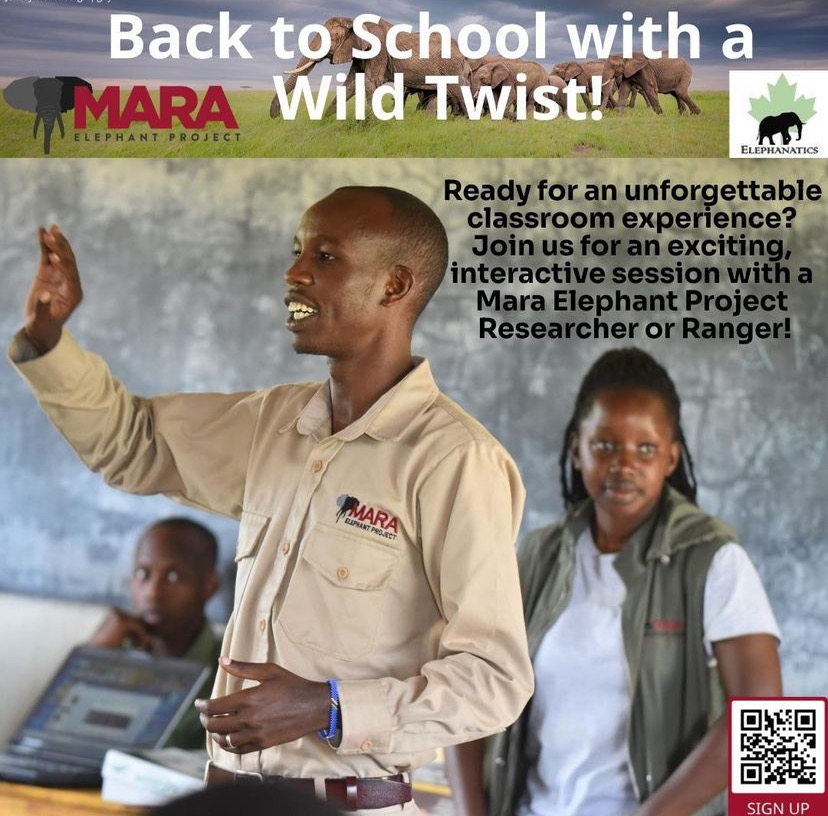
It’s Back To School and we have some great news for all educators!
Elephanatics and Mara Elephant Project are offering educators a unique opportunity to invite via Zoom a Mara Elephant Project ranger or researcher into your classroom. Students will have the chance to interact with a Kenyan conservationist and learn more about the work they are doing to protect elephants and their habitats in the Greater Mara Ecosystem.
Go to link below to book your spot today and share with fellow friends, teachers and educators!
The Honourable Steven Guilbeault, P.C., M.P., Minister of Environment and Climate Change, House of Commons, Ottawa, ON K1A 0A6 via email: Steven.Guilbeault@parl.gc.ca
cc:
Hon. Mary NG, P.C., M.P., Minister of Export Promotion, International Trade and Economic Development – mary.ng@parl.gc.ca Hon. Mélanie Joly, P.C., M.P., Minister of Foreign Affairs – melanie.joly@parl.gc.ca Hon. Jonathan Wilkinson, P.C. M.P., Minister of Energy and natural Resources – jonathan.wilkinson@parl.gc.ca Christopher Thornley, High Commissioner for Canada to the Republic of Kenya – nairobi@international.gc.ca
July 12th, 2024
Dear Minister Guilbeault,
Elephanatics, a Vancouver based elephant advocacy organization and co-leader of the Ivory-Free-Canada campaign, thanks you and your team, again, for implementing regulations to end the trade of elephant ivory and rhino horn in Canada.
As you know, elephants are a highly endangered keystone species that are not only emotionally intelligent but central to maintaining vibrant local biodiversity and ecosystems. While the Canadian ivory ban is essential to their protection, the threats facing elephants are multiple and, unfortunately, ongoing.
Recently, a thirty-year moratorium protecting elephants along the Kenyan and Tanzanian border has ended with the killing of 5 large male tuskers. Elephants along this border travel historic migratory routes which are now endangering them.
These elephants, also known as “Super Tuskers”, are male elephants with at least one tusk weighing 100 pounds (45kg). It is believed that there are as few as 50 left in Africa. They are critically important for stability in elephant societies and their habitats and ecosystems.
Dr Joyce Poole, co-founder and Scientific Director of ElephantVoices, says, “Fifty years of research on Amboseli’s known individuals has shown that males between 35 and 55 years of age are the primary breeders. Hunters who claim that older males are “dead wood” are just plain ignorant of the science. Males who are given the chance to live to an old age produce a disproportionate number of offspring, passing their genes to the next generation. By killing large tusked males hunters are damaging elephant society, negatively impacting Amboseli’s rare gene pool for large tusks and taking a toll on its future tourism potential.”
Canada has played a leading role in the protection of wildlife and biodiversity and at COP15 participants agreed to the Kunming-Montréal Global Biodiversity Framework, a historic global framework to safeguard nature and halt and reverse biodiversity loss, putting nature on a path to recovery by 2050.
COP15 focused on protecting nature and halting biodiversity loss around the world. The Government of Canada’s priority was to ensure the COP15 was a success for nature.
We are asking that Canada use its international influence, powers of collaboration and voice to advocate for the following:
Review and amend current wildlife hunting regulations to protect critically important elephants by restricting hunts in areas where these tusker elephants roam.
Implement a formal buffer zone near the Kenya- Tanzania border safeguarding the transboundary elephant population, recognizing their significant ecological economic and symbolic value.
Enhance conservation efforts and promote ecotourism as sustainable alternatives that can support community development without sacrificing invaluable wildlife.
Elephant Voices, Big Life Foundation and the Amboseli Trust for Elephants, released a statement appealing for “an end to elephant trophy hunting in the Enduimet Area of Tanzania”. We add our voice to the growing alarm over the hunting of these few remaining tuskers.
As we enter another summer of record breaking heat , storms, and wildfires, the global commitment to preserving our planet’s magnificent and indispensable ecosystems is more urgent than ever.
As elephants are a highly endangered species, we ask that you act with urgency to address this matter.
📣 Congratulations 📣 to the four new recipients chosen for the Fran Duthie African Elephant Conservation Scholarship! 🎓
If you wish to support the next generation of wildlife conservationists in Kenya visit the Mara Elephant Project donate page and leave a note that it is for the scholarship.
Our future lies in their hands!
………………………………
The Fran Duthie African Elephant Conservation Scholarship overseen by Mara Elephant Project launched in 2022 provides financial assistance to Kenyans pursuing conservation or related fields through a technical certificate, undergraduate or postgraduate degree. The inaugural recipient Janeth Jepkemboi is completing her MSc in Environmental Studies after spending time at MEP HQ in the first quarter, and now a new group of students is eager to follow her lead as the next recipients of the scholarship. After a thorough selection process, we are pleased to introduce the four new students receiving the Fran Duthie African Elephant Conservation Scholarship.
This #GivingTuesday, you can support the next generation of Kenyan conservationists by contributing to the Fran Duthie African Elephant Conservation Scholarship distributed by Mara Elephant Project (MEP).
Your support will help grow the fund to create more opportunities for students pursuing a degree in a conservation related field. Students like Janeth Jepkemboi, the first recipient of the scholarship says, “My continued studies in environmental science have furthered my passion for conservation. This scholarship is an opportunity for me to gain skills that I will use to put my passion to action at a Kenyan conservation organization. This type of opportunity is the best way for me to influence policy that safeguards livelihoods while still protecting biodiversity.” The scholarship also supports building Janeth’s field experience and resume through an internship at MEP.
Give to help young Kenyans like Janeth gain the education and experience they need to find solutions that benefit both people and wildlife. The future of our planet depends on it!
Donate this GIVING TUESDAY here*Please state in the comments section under ‘Donate Now’ that you would like your money deposited to the Fran Duthie African Elephant Project Scholarship.