A Triumphant Recognition! A huge Congratulations!

Group of African elephants in the wild


It is with great pride and excitement to announce that Dr. Jake Wall, co-founder of Elephanatics and EarthRanger, has been awarded the Esmond B. Martin Royal Geographic Society Prize for 2025 – an honour recognizing outstanding individual achievement in the pursuit and application of geographical research, with a particular emphasis on wildlife conservation and environmental research studies.

“Dr Wall has been at the forefront of leveraging technology to create freely available geospatial tools for the benefit of wildlife conservation in Africa and beyond for the last 20 years. Jake’s dedication and passion for wildlife is matched only by his tireless efforts to provide conservationists with the tools and methods they need to better protect the natural world.His approach has been methodical and detailed focusing on the benefits, not only to the natural landscape, but the communities that live along side these majestic animals.

As Director of Research and Conservation for the Mara Elephant Project (MEP), Jake established a long-term elephant monitoring programme and developed an application to easily map landscapes, especially fences, which have become a major threat to wildlife movements in the Mara ecosystem. Prior to working with MEP, Jake worked as the Geospatial Scientific Advisor to Save the Elephants for 15 years where he developed a real-time tracking system to visualise GPS data from collared African elephants across the continent. Algorithms scanned the data and, among other things, sent alerts when elephants had moved unusually fast, suggesting panic, or had stopped moving which might indicate a poaching event. In partnership with Save the Elephants and the Allen Institute for AI, this system was expanded into EarthRanger, now used by over 600 sites across 74 countries and growing rapidly.

To complement EarthRanger, Jake is now leading the development of Ecoscope, which provides users with access to ready-made analytics from sources of publicly available remote sensing data. It allows researchers and conservationists to easily engage with the data and generate meaningful outputs, thereby turning conservation data into information to improve decision making, insight and the protection of ecosystems.”

Congratulations Jake! You are very deserving of such a prestigious acknowledgement. Team Elephanatics is extremely proud of all your hard work and devotion to protecting the greatest animal ever created!

The elephants trumpet! 🐘

EarthRanger EcoScope


Canada last again….

It’s  WorldWildlifeDay 

Canadian organizations are calling on Canada this World Wildlife Day to fulfill its obligations from CITES routine decisions made in 2022 that protect over 500 endangered species.

After two years since the last Convention on International Trade in Endangered Species (CITES), Canada is the only country out of 185 parties that has not updated its control list of endangered species making Canada an open conduit for trafficking in these species.

Canada needs to do better!

Please read letter to Ministers below:

Canada last – again – to protect more than 500 species 3 March 2025


*****  UPDATE April 2nd, 2025 Government amended regulations


Happy News for the First Month of 2025!

Elephanatics is very pleased to share the most recent updates from the four recipients of the Fran Duthie Scholarship administered by our partner organization, Mara Elephant Project, in Kenya.

Learn about the exciting work these students are undertaking in conservation related fields. By securing an education for the next generation in wildlife conservation, we are helping to secure a healthy future for our planet as well. We wish them continued success with their programs!

If you’re interested in learning more about how you can support the scholarship fund in 2025, please email us or make a donation today. 

#maraelephantproject

An Update from the Four Recipients of the Fran Duthie Scholarship


#BlackFriday and #GivingTuesday

Greetings fellow elephant lovers!

We have some wonderful ideas on how to give back and support wildlife conservation too!

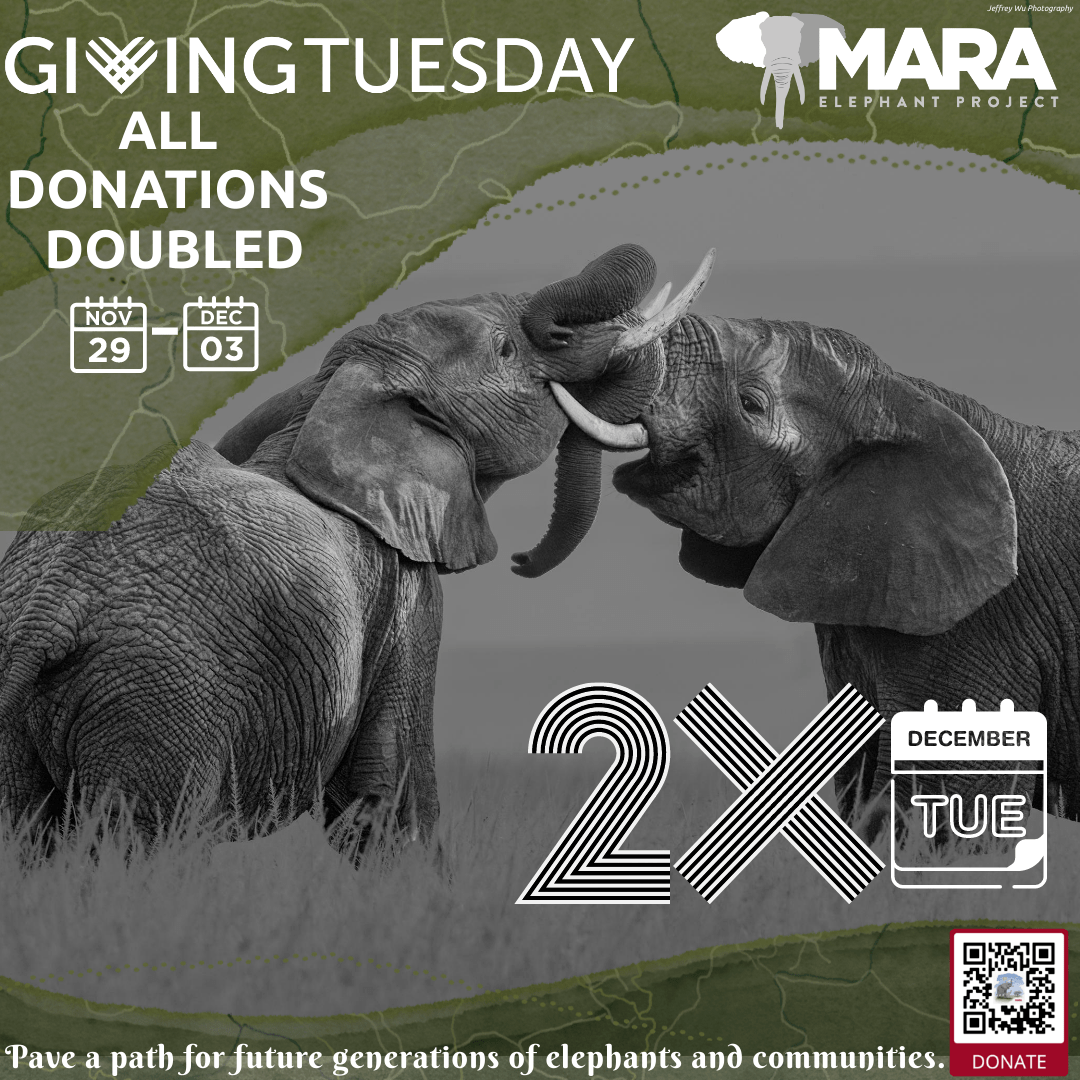
This #BlackFriday and #GivingTuesday Elephanatics is acknowledging the outstanding work efforts of the Mara Elephant Project in the Maasai Mara, Kenya. They have been a long-standing partner of Elephanatics and are top leaders in elephant conservation in Africa. We are grateful for their protection of wildlife through innovative techniques and technologies advancement to their dynamic co-existence strategies used to create economically resilient communities by cultivating and growing elephant friendly crops! We are proud to support and donate to their organization!

Starting November 29, Black Friday, thanks to the generosity of a donor, Mara Elephant Project is matching all donations up to $50,000 through to #GivingTuesday, December 3rd. The actions that MEP are taking now are paving pathways for future generations of elephants and communities that call the Mara home. Don’t miss the opportunity to help African communities retain their natural heritage by supporting their work. You can purchase their handmade items in link below:
https://linktr.ee/maraelephantproject?utm_source=linktree_admin_share

Double your impact by donating to Mara Elephant Project today to secure a future for elephants. You can also donate to Elephanatics as all our donations go directly to the Mara Elephant Project.

We thank you for your continued love of elephants and that you appreciate the amount of time, money, and effort it takes to protect these magnificent animals. We wish you a very happy, and healthy, holiday season ahead!

The Elephanatics Team!

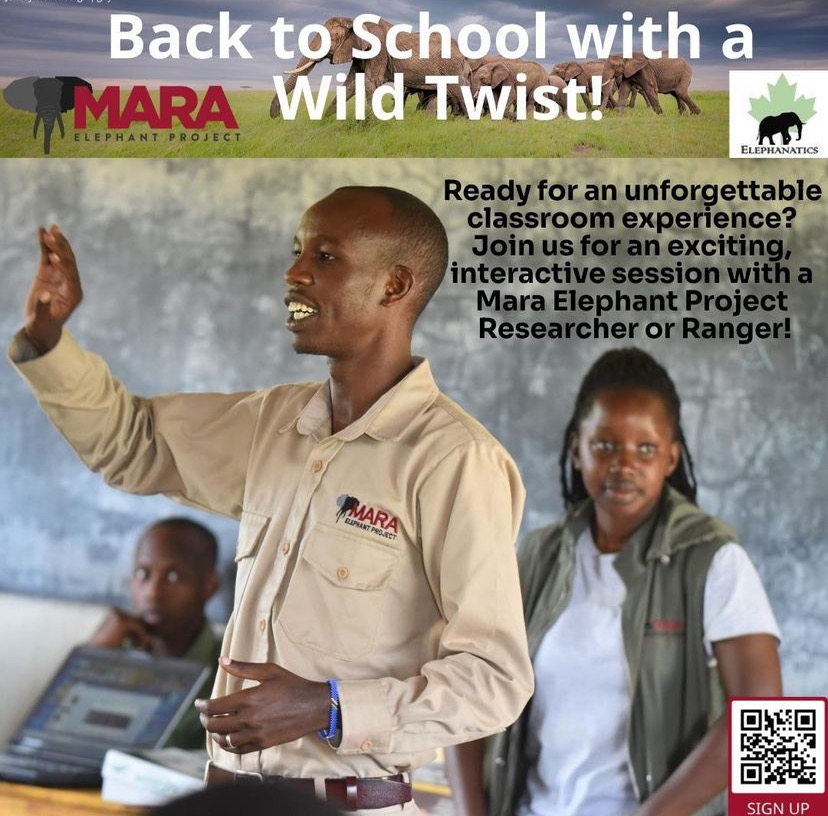
BRING A WILDLIFE RANGER OR RESEARCHER INTO YOUR CLASSROOM!

It’s Back To School and we have some great news for all educators!

Elephanatics and Mara Elephant Project are offering educators a unique opportunity to invite via Zoom a Mara Elephant Project ranger or researcher into your classroom. Students will have the chance to interact with a Kenyan conservationist and learn more about the work they are doing to protect elephants and their habitats in the Greater Mara Ecosystem.

Go to link below to book your spot today and share with fellow friends, teachers and educators!

"Elephanatics Foundation - Free elephant conservation lesson plans, toolkits for teachers, and persuasive essay resources."

Educational Resources

Meet the New Class of Fran Duthie Scholarship Recipients 2024!

cr. Larry Lavery photo

📣 Congratulations 📣 to the four new recipients chosen for the Fran Duthie African Elephant Conservation Scholarship! 🎓

If you wish to support the next generation of wildlife conservationists in Kenya visit the Mara Elephant Project donate page and leave a note that it is for the scholarship.

Our future lies in their hands!

………………………………

The Fran Duthie African Elephant Conservation Scholarship overseen by Mara Elephant Project launched in 2022 provides financial assistance to Kenyans pursuing conservation or related fields through a technical certificate, undergraduate or postgraduate degree. The inaugural recipient Janeth Jepkemboi is completing her MSc in Environmental Studies after spending time at MEP HQ in the first quarter, and now a new group of students is eager to follow her lead as the next recipients of the scholarship. After a thorough selection process, we are pleased to introduce the four new students receiving the Fran Duthie African Elephant Conservation Scholarship.

https://buff.ly/3UULV8s

BREAKING NEWS: Canada enacts historic ban on elephant ivory and rhino horn trade

Elephanatics is Ecstatic to Announce:

After 8 long years of advocating for a ban on elephant ivory and rhino horn in Canada, regulations have been enacted by the Canadian Government to ban the elephant ivory and rhino horn trade, along with the import of hunting trophies containing these parts. We couldn’t be happier to deliver this news to all our followers and supporters who have been our backbone and inspiration to carry on and get this job done! It took a lot of courage, but – We did it!

Firstly – A HUGE shout out to us – ‘Team Elephanatics’ – who created the #IvoryFreeCanada campaign and were joined by Humane Society International Canada, Rhino and Elephant Defenders, World Elephant Day and the Jane Goodall Institute of Canada, to form the Ivory Free Canada coalition. Together, we have been relentless in our mission to get this ban passed!

And secondly, an even bigger thanks to all the scientists, NGOs, politicians, the Ivory Free Canada coalition, volunteers, friends, family, educators, journalists, and people who worked tirelessly to make this happen. From the petition, started by the Ivory Free Canada coalition, that reached over 700,000 signatures that showed overwhelming support by citizens to save elephants and rhinos; to endless advocacy; to the collaboration of like minds working together to save a species, the end result has been a success. It took a village and a community dedicated to the cause of making the world a better place for elephants to get this done and we should all be stupendously proud of our efforts!

Who would have ever guessed that a small group of committed and disciplined people, who advocated for the betterment of elephants, could evoke such integrity and inspiration from like-minded partners, and see their dream come to fruition. We are humbled and grateful.

With deepest respect, thanks, and love, to everyone who was part of this enormous endeavour.

Fran Duthie
President Elephanatics

“With courage, you will dare to take risks, have the strength to be compassionate, and the wisdom to be humble. Courage is the foundation of integrity.”

Mark Twain

Read Full Press Release  – Humane Society International Canada

https://www.hsi.org/news-resources/canada-enacts-historic-ban-on-elephant-ivory-and-rhino-horn-trade/

Strengthening the International Legal Framework to Tackle IWT

Elephanatics, along with other organizations and subject-matter experts, has co-signed and supports initiatives introduced and outlined in a letter written by John Scanlon, Chair, Global Initiative to End Wildlife Crime. The letter addresses the need to strengthen the international legal framework against wildlife trafficking and was sent to Canada’s Environment Minister, Steven Guilbeault, requesting the Government of Canada support an additional Protocol to the UNTOC to prevent and combat wildlife trafficking.
Please read letter in full in link below.

The Honourable Steven Guilbeault, P.C., M.P. Minister of Environment and Climate Change House of Commons
Ottawa, ON
K1A 0A6
via email: Steven.Guilbeault@parl.gc.ca

cc:
Hon. Mélanie Joly, P.C., M.P., Minister of Foreign Affairs melanie.joly@parl.gc.ca
Hon. Arif Virani, P.C., M.P., Minister of Justice and Attorney General of Canada arif.virani@parl.gc.ca

September 7th, 2023

Dear Minister Guilbeault,

We are writing to better understand Canada’s views on how best to tackle wildlife trafficking at the international level, and to encourage the Government to further consider the merits of an additional Protocol to the United Nations Convention against Transnational Organized Crime (UNTOC).
The size and scale of wildlife trafficking is a truly global challenge and one that demands urgent action. The value of illegal trade has been estimated at between $7 and $23 billion per year. A report by FINTRAC acknowledges that “illegal wildlife trade not only affects Canada, but poses a serious threat internationally”. Canada has signaled that this is a priority issue to address, both at home and abroad, and we were pleased to see the inclusion of the subject in the December 2021 Mandate Letter for the Minister of Environment and Climate Change Canada (ECCC) committing Canada to “work with partners to curb illegal wildlife trade”…….

Read letter here:  Letter on strengthening the international legal framework to tackle IWT – Government of Canada


Happy World Elephant Day 2023!

Celebrate #WorldElephantDay today by donating to your favourite elephant conservation organization!

#IvoryFreeCanada

https://worldelephantday.org/news/2023/08/an-ivory-free-canada-is-almost-here?fbclid=IwAR3C1NkJYmbs8UaZEThTsfDDR81gd38sJtQerwN9kkLGvTRtm5oXtH1x4h4

What Happened to Protecting Elephants and Rhinos?


“Elephants are not human, of course. They are something much more ancient and primordial, living on a different plane of existence. Long before we arrived on the scene, they worked out a way of being in the world that has not fundamentally changed and is sustainable, and not predatory or destructive.” 
 
Alex Shoumatoff


One might question why humanity continues to be a formidable and increasingly detrimental threat to nature, while nature continues to be the only hope left for our survival. The phrase, ‘cut off your nose to spite your face,’ comes to mind. 

Undeniably, humankind has never fathomed the nuances required to sustain a viable and healthy world, but rather has created an ecological and environmental conundrum that will be the demise of our species and many other species, unless immediate action is taken to reverse this deleterious trend. Elephants and many other wildlife species are becoming extinct from the increased threat of habitat loss and the illegal wildlife trade mainly due to humanity’s ignorance.  

In March 2022, the Canadian government mandated to end the elephant ivory and rhinoceros horn trade and work with partners to curb the illegal wildlife trade in Canada. We are still waiting for action to be taken on this initiative. The following information reaffirms the necessity to get this mandate done as soon as possible:

In a report by the International Monetary Fund (IMF) Finance and Development department, the carbon value of a single forest elephant is worth $1.75 million dollars. Elephants help mitigate climate change by maintaining forest and savannah ecosystems for other species and are integrally tied to rich biodiversity.

In a study done by Yale school of the Environment on climate change, Professor Oswald J. Schmitz states, “Wildlife species, throughout their interaction with the environment, are the missing link between biodiversity and climate. This interaction means rewilding can be among the best nature-based climate solutions available to humankind.” 

The data in this study showed that protecting or restoring wildlife populations could collectively facilitate the additional capture of 6.41 billion tons of carbon dioxide annually. This is 95% of the amount needed every year to meet the Paris Agreement target of removing enough carbon from the atmosphere to keep global warming below the 1.5-degree Celsius threshold. The health of our planet is ultimately dependent on healthy biodiversity and ecosystems globally.

To be certain, the elephant ivory trade dates back to the 14th century. During the colonization of Africa, approximately 800 to 1,000 tonnes of ivory was sent to Europe every year to be used for making piano keys, billiard balls, and other usages. By the 1970’s Japan consumed approximately 40% of the global trade and another 40% was consumed by Europe and North America. 

Fast forward to today and China has become the largest consumer of ivory products in the world where the vast majority of smuggled ivory—experts say as much as 70 percent—ends up. With increased economic growth, a wealthy Chinese middle class has fuelled the demand for luxury ivory products and although seizures of illegally obtained ivory take place, much of the smuggled ivory still gets through. The Convention on International Trade of Endangered Species (CITES) reports that nearly all the current demand for elephant ivory comes from the Chinese market.

In March of 2021, the African forest elephant, Loxodonta cyclotis, was listed as critically endangered and the African savanna elephant, Loxodonta africana, as endangered on the International Union for Conservation of Nature (IUCN) Red List of Threatened Species. The causes are identified as poaching for ivory in the short term and habitat loss in the longer term. The number of African forest elephants fell by more than 86% over a period of 31 years, while the population of African savanna elephants decreased by at least 60% over the last 50 years. The Red List continues to classify the Asian elephant as endangered with as little as 52,000 left in the wild.  

According to an IUCN Report, approximately 111,000 elephants were lost between 2006-2015 leaving an estimated 415,500. In the last forty years, elephant habitat has decreased by nearly two thirds largely due to human activities.

A paper led by the Mara Elephant Project’s Director of Research and Conservation Dr Jake Wall, discovered that human activity largely shapes the behaviour and distribution of modern elephants. 62% of Africa has suitable habitat for elephants, but the animals use just 17% of that habitat and are absent – for now – in the remaining 83%.

Along with poaching, the demand for rhino horn is highly sought after for Traditional Chinese Medicine use. The trade of TCM using body parts of IUCN red-listed animals must be regulated. Additionally, new research by Vincent Nijman, Professor in Anthropology at Oxford Brookes University states, “With three out of four newly emerging infectious human diseases originating in animals, there is an urgent need to monitor the legal trade in wildlife… given that in many instances the legal wildlife trade is several orders of magnitude larger than the illegal trade, it is ineffective and possibly dangerous to focus on the illegal wildlife trade only.” Pandemics will continue as long as the legal trade in wildlife goes unabated.

Consequently, wildlife trafficking has quickly become a multi-billion-dollar transnational criminal activity that is not only a conservation issue but also a security threat. It is ranked as the fourth most profitable transnational crime, only behind the drug trade, arms trade and human trafficking. During the pandemic, there was a significant shift toward online sales of ivory, particularly on eBay and social media.

In May of 2022 the UN moved closer towards tackling the illegal wildlife trade. The UN Commission on Crime Prevention and Criminal Justice (CCPCJ) adopted an historic resolution. Angola, Kenya, and Peru submitted the draft resolution in April. It was titled ‘Strengthening the international legal framework for international cooperation to prevent and combat illicit trafficking in wildlife.’ It called on the UN Office on Drugs and Crime (UNODC) to consider the benefits of adopting an additional protocol in the UN Convention against Transnational Organized Crime (UNTOC). 

This additional protocol would be specifically about preventing and combating the illegal wildlife trade. Current protocols in UNTOC cover the trafficking and smuggling of people, and the manufacturing and trafficking of arms. This is a step in the right direction!

Furthermore, in February of 2023, a new public-private partnership, targeting the global black market in wild animals and their body parts, was initiated by Scotiabank and FINTRAC, which encourages  information sharing between financial institutions, conservation groups, and financial intelligence units in Canada, South Africa, Australia, the U.K and elsewhere. This is a huge initiative and targets the middlemen responsible for illicit wildlife trafficking. 

Money laundering plays a significant role in the illegal wildlife trade with criminals looking for an easy way to move whatever commodity they can to make a profit. Sam Cooper, Canadian investigative journalist and founder of The Bureau says that international law enforcement have identified networks of hunting junket operators in Canada, Latin America, Africa and Australia, intertwined with fentanyl traffickers and Chinese state actors. Cooper said illegal wildlife hunting and trafficking facilitate laundering of drug cash and movement of narcotics for gang bosses, but junket operators also use illegal big game hunting as a social networking tool, gathering gangsters, corrupt officials, and state actors. “Vice and profit go hand-in-hand in these international crime and corruption networks,” Cooper said. 

While strong law enforcement initiatives are imperative to curb the illegal wildlife trade, the fact remains that habitat loss, poaching, human-elephant conflict, trophy hunting, and the legal ivory trade are still enormous threats contributing to elephant population declines and their survival.

We continue to encourage the Canadian government to follow through with its mandate as a matter of urgency and we ask that you do the same.

Please Take Action to make sure the government fulfills its obligation and stops stalling on its commitments. 

 “In the end … success or failure will come down to an ethical decision, one on which those now living will be judged for generations to come.”   Edward O. Wilson

Fran Duthie
President / Co-Founder
Elephanatics