Rewilding Day – March 20th

Rewilding Humanity

“May Man and Beast
succeed to coalesce harmoniously,
in the forests, the seas, and land,
with ner’er a compromise from Nature.”
fd

There is a tragic urgency in the world today for the necessity to compromise. Compromises for wildlife. Compromises for nature. But, above all else, the ability to compromise humanity’s own platitudes for the sake of Mother Earth. David Attenborough said it best, “Nature once determined how we survive, now we determine how nature survives.” Only by compromising will we find an equilibrium that will provide a solution to prevent critical mass extinction of wildlife and our own species.

Rewilding is a concept that has gained larger recognition worldwide because of the irreparable damage caused by humans to wild spaces that were once occupied by species responsible for healthy ecosystems and biodiversity. Conservationists understand the frailty of our existence and the connection between nature and mankind as synergistic. Therefore, if the basis of rewilding be to govern all natural processes, then it must be said that the basis of rewilding humanity be at its core.

What is rewilding and why do we need it?

Rewilding is a progressive form of conservation that restores and rebalances ecological areas that have suffered from overuse and abuse from humans, allowing nature to repair itself through natural processes with as little human interference as possible. It helps ecosystems rebuild diversity, structure and resilience. It is imperative for all life on Earth to have healthy, regulated ecosystems to counter the extinction crisis, preserve biodiversity, and help mitigate human-made climate change.

Rewilding consists of 3 major success categories: Cores, Corridors and Carnivores.

Cores are wild spaces linked up by corridors that enable carnivores, or other keystone species, to be reintroduced to areas where they once roamed, and now have the opportunity to flourish and regenerate ecosystems that were once part of the landscape. Corridors are natural or man-made strips of land connecting cores and serving as an avenue for wild animals to move across to reach food, water and cover. Increasing habitat fragmentation has put these essential movements at risk.

Large predators play a key role in regulating ecosystems. By connecting core areas through natural corridors, big predators can reach wild land networks.

Generally speaking, populations of wild animals are naturally regulated. There are two forms of food regulation. One form of is bottom-up control – meaning the flow of energy and nutrients from the soil through to the plants to the herbivores and on up to the predators. Another form is top-down control where predators control herbivores or other smaller predators (predation), which indirectly affects plants and even soils, referred to as a trophic cascade. Elephants are plant predators – a top-down control (food regulation) of plants and trees in the ecosystems in which they live. In the savannah elephants affect tree populations by eating small seedlings thus preventing trees from returning keeping the vegetation open. One of the most frequent causes of ecosystem collapse is the loss of top predators. Human hunting, urban development and agriculture has prevented regulation of herbivores by top predators by displacing or killing them causing a chain reaction in the food chain.

In any ecosystem, the loss of a keystone species results in a loss of biodiversity at other levels in the food chain. Elephants have decreased by nearly two-thirds largely because of human activities in the past 40 years and because elephants are a keystone species, this has greatly affected the ecosystems in which they live and all the other animals that depend upon them for survival. A principal driver for the decline and extinction of a species is the loss of their habitat. An important pillar of rewilding is the reintroduction of keystone species to areas that have been degraded in order to rebuild stability and diversity.

Rewilding is a complex and intricate process of re-establishing ecosystems to the original form had human disturbances not occurred. Long-term monitoring is essential in tracking rewilding programs. By having a long-term goal it allows scientists to track a systems progress and intervene if it deviates because of external threats such as poaching.

So, how does all this pertain to humanity and its role in the extinction crisis and what constructive tactics could we practice in order to assist the rewilding concept?

It is a disheartening fact to know that 96% of the mass of mammals on the planet today are humans and the livestock we have domesticated. Only 4 % is everything else, meaning wildlife is at the bottom of the barrel. 70% of all birds are domesticated poultry, mainly chickens. The speed at which species are disappearing is at least 100 times higher than the natural rate of extinction. At the current rate it will take millions of years for diversity to be restored to pre-industrial levels. How do we halt this tsunami?

If we were to say that humanity’s success is governed, largely, by 3 major success categories to include competence, commitment, and collaboration, we could discern and conflate the principles of rewidling with our own principles of humanity. We could also broaden the categories to include; compassion, conscience, culture, community, and co-existence.

From the beginning of time, mankind has been ingenious and competent enough to protect itself from extinction. But, we have reached a global population growth of 8+ billion people that are pillaging the earth’s resources at mammoth speed. A commitment to evaluate our consumption practices and place nature at the top of our list of collaborators is imperative for all survival on earth and a true test for humanity. Are we competent enough to succeed? Our sub categories of success, to include compassion and conscience, will need to place an emphasis on rewilding humanity as its primary goal in order for rewilding nature to be successful. Cultural norms will need to be reevaluated, and educational programs in communities and schools will need to be organized to teach the importance of co-existence with nature as our primary connection and means to survival. It is encouraging to know that some conservation organizations are focusing on the importance of rewilding and making it their primary objective.

We are bound, intrinsically, to nature. From the elephant that tramples copious amounts of seeds in the forest that, in turn, nourishes life in ecosystems, to the stars we gaze at with wonderment, in the night sky, that are part of our DNA. Compromises are urgent proponents to change that humans are irrevocably responsible for in order for rewilding to succeed and humanity to continue to exist.

The truth is, nature does not compromise. We must.


Below are some suggestions on how to ‘Rewild Humanity’ and top reasons why we should:

  • Animal agriculture is responsible for 91% of Amazon destruction. If we all ate less meat, there would be more space for wildlife to flourish. Fewer crops would be needed to feed livestock. infographic: https://www.cowspiracy.com/infographic

Top reasons why we need to rewild:

  • To stop mass extinction
  • To bolster biodiversity and stabilize climate on which we all depend
  • To prevent natural disasters
  • To increase economies of scale for communities
  • To help people by securing high levels of biodiversity


Fran Duthie,
President / Elephanatics


*All rewilding statistics listed above accredited to “A Place Like No Other”
author, Anthony R.E. Sinclair, with Rene Beyers, director, Elephanatics

Classroom Presentations at Art and Play Foundation!

Our student ambassador, Muskan, gave two informative and insightful presentations to the children attending the Art Therapy Program at Kids Play Foundation in Surrey last Saturday.  The kids learned about the many faceted roles the elephant plays in keeping ecosystems in which they live healthy and their role as a keystone species. Lots of giveaways and fun was had by all.

Thank you, Muskan, for your great work. The elephants trumpet!!


Elephants and Biodiversity – How are they connected? NEW Lesson Plan!

Elephants and Biodiversity – How are they connected? NEW LESSON PLAN!

"Elephanatics Foundation - Free elephant conservation lesson plans, toolkits for teachers, and persuasive essay resources."The decline of elephant populations due to the illegal wildlife trade and poaching is now almost the stuff of legendary horror. While elephants roamed the forests and savannas of Africa in the millions in the past, the 20th century has seen an accelerated assault on their lives with populations declining from 10 million in the early 1900s to approximately 450,000 today.

While poaching threats continue unabated, climate change, biodiversity loss, and human wildlife conflict are equally as threatening to the long-term survival of Africa’s elephant populations.

Elephants are at the crossroads of multiple human system failures. In Kenya, 200 elephants died recently due to the drought bringing elephants in closer conflict with humans competing for limited resources.  As a keystone species the loss or potential extinction of elephants will have devastating consequences for ecosystems dependent on them for their survival, driving a circle of degradation for all species, including humans.

How do we emerge from this human created mess? Elephanatics is committed to providing resources and education for people of all ages, with the intention of helping people understand that elephants, like the rest of the natural world, are an integral part of a broader ecology that help form the fabric of ecosystems essential to our collective survival. In Elephanatics’ latest lesson plan “Biodiversity and the Important Role of the African Elephant,” students from grades four to twelve will learn how to:

  • Correctly use appropriate science vocabulary to include – biodiversity, keystone species, natural community, interrelationships, and characteristics.
  • Describe interrelationships between the African elephant and their environment. Using pictures and words, explain why the African elephant is a keystone species.
  • Identify human-caused species loss as one of the major current threats to biodiversity.
  • Explain how the disappearance of the African elephant affects other species.

Link to lesson plan here.

View all our lesson plans here.   All plans can be modified to suit grade appropriateness.

With a commitment to supporting education for future generations on the importance of protecting wildlife and biodiversity, we hope to ensure the long-term survival of Africa’s remaining population of extraordinary wild elephants.

Giving Tuesday November 29th


It’s Giving Tuesday November 29th

This #GivingTuesday we are asking you to help support the work of Elephanatics to build conservation educational capacity in Kenya by donating to the Fran Duthie African Elephant Conservation Scholarship held with Mara Elephant Project, an African conservation organization in Kenya dedicated to protecting elephants and their habitats.

The scholarship provides financial support to Kenyan nationals acquiring a technical certificate, undergraduate or postgraduate (Masters or PhD) degree in an area related to conservation and the protection of wildlife.

Janeth Jepkemboi was the first ever recipient of the scholarship.

Janeth began her master’s program at Karatina University studying environmental science. Janeth’s parents worked hard to put her through high school, and she helped by doing fundraisers. To pursue her undergraduate degree, she took out loans and worked throughout. Janeth was an exceptional candidate for this scholarship.

“My undergraduate studies in environmental studies made me passionate about conservation and I love connecting with nature. This scholarship is an opportunity for me to gain skills and academic excellence that I will use after as I envision working with a conservation organization and being at a level where I can influence policy to safeguard livelihoods while still protecting biodiversity values. This scholarship will be a great opportunity to realize my dreams and be an asset to the community.”

Janeth’s first semester consists of 7 units to include Conservation & Planning of Biological Resources, Environment & Development, among others. She is currently working on numerous assignments and term papers and will be writing her end of semester exams in January. We wish her every success and know she will do well.

The future of our wildlife depends on students, such as Janeth, to bring innovative change to conservation methods and modalities. We are all interdependent on nature for our own survival. Please consider investing in students who will provide the expertise necessary to make these changes.

 Donate Here

* Please state in the comments section under ‘Donate Now’ that you would like your money deposited to the “Fran Duthie Scholarship”.


CITES CoP19 Letter to MP’s

October 15, 2022

Dear Member of Parliament,

We are a coalition of organizations calling for urgent action to be taken at the upcoming CITES-CoP19 taking place in Panama City, Panama, November 14-25. (https://cites.org/eng/cop19).

We oppose:

a.) The proposal to CITES by Zimbabwe at the upcoming convention to amend Annotation 2 pertaining to the populations of Botswana, Namibia, South Africa and Zimbabwe as specified here: https://cites.org/sites/default/files/documents/E-CoP19-Prop-04_1.pdf

b.) The proposal by Namibia and Botswana to transfer Namibia’s population of southern white rhinos from Appendix I to Appendix II to facilitate trophy hunting and live animal trade for in-situ conservation purposes, as specified here: https://cites.org/sites/default/files/eng/cop/19/prop/as_received/E-Ceratotherium_simum_simum-Namibia.pdf

We support:

The proposal by Burkina Faso, Equatorial Guinea, Mali, and Senegal to transfer African Elephant populations in Botswana, Namibia, South Africa and Zimbabwe from Appendix ll to Appendix l.1

https://cites.org/sites/default/files/eng/cop/19/prop/as_received/E-Loxodonta_africana-Transfer_App_I.pdf

Read full letter here: Dear Member of Parliament

It’s Friday the 13th but Good Luck for Us!

ELEPHACT FRIDAY:
Volunteers Make ALL The Difference! 
A big thank you to our grade 11 student volunteer, Muskan Sadioura, who has been super proactive in sharing Elephanatics mission to protect the African and Asian elephant!
Muskan is a student at Fleetwood Park Secondary School in Surrey and has worked diligently at sharing our lesson plans with teachers, encouraging other students to support us, and has given an announcement to her whole school about our organization.
She will be introducing Elephanatics to her elementary school’s student council this June and will give a school wide announcement next October about our organization. She has also offered to deliver presentations to summer camps that have requested us to speak this summer.
We can’t thank her enough for her passion and drive to support elephants and her desire to give back to the community.
Thank you, Muskan!!
Pic 1) Muskan delivers announcement to school.
Pic 2) Display in Fleetwood Park Secondary School hall on elephants.

Student Takes A Stand For Elephants!

Calling All Students!

We are so pleased to share our student volunteer’s blog, “Help Save the Enchanted Elephant.” Dhanvin is a grade 10 student attending Kwantlen Park Secondary School in Surrey. From his experience growing up in Asia, he has a keen sense of the need to protect this valuable species. We thank him for his time and efforts at promoting the work we do as an organization at his school.

Help Save the Enchanted Elephant

(My teacher giving an info session on Effects of Elephant Poaching)

May 9th, 2022

Hi, my name is Dhanvin. I am a grade 10 student attending Kwantlen Park Secondary School in Surrey, BC, Canada. I have offered to volunteer with Elephanatics – an elephant advocacy organization based in Vancouver – to help spread awareness about the crises facing both the African and Asian elephant and the necessity to help save these majestic animals.

Growing up in Asia I have a deep connection with Elephants. I have admired these fascinating creatures since my childhood. Elephants play a significant role in my culture. I had the privilege to touch and ride on one. I vividly remember riding on a 20-year-old Asian elephant. It felt magical riding on this magnificent creature. Riding over 7 feet high through a thick green luscious forest gave me the opportunity to reflect and reconnect with nature. This is one of my favourite memories that I will cherish all my life. Little did I know at the time that riding elephants is not good for them and can cause unnecessary pain to their backs. After reading about unethical tourism, I realized I needed to make others aware that in order to ride elephants they have to go through a horrible procedure to become tame called, ‘Phajaan’ or ‘the crush’. It means to break their spirit and they are beaten to become domesticated. Unethical tourism is a big problem and needs to end.

African and Asian elephants are powerful, compassionate and magnificent animals. They are also ecosystem engineers, playing a critical role in shaping the natural environments where they live. Ecosystems are a complicated web where animals and plants depend on each other for survival. Ecosystems have been developing and evolving for eons. It is depressing to see humans wreck these fascinating systems in just a few decades. Disrupting the balance of ecosystems can threaten human life existence on earth. In spite of the efforts from some governments, the number of African forest elephants fell by more than 86% over a period of 31 years. The African Forest Elephant is Critically Endangered and the African Savannah Elephant is Endangered and on the International Union for Conservation of Nature (IUCN) Red List of Threatened Species.

The Asian Elephant is listed as Endangered because of a population reduction to be at least 50% over the last three generations. The biggest threat to Asian and African elephants now is habitat loss and fragmentation.

Some of the main reasons threatening the existence of elephants include:

Poaching

Elephants are most vulnerable to poaching for ivory and bush meat. Unfortunately, many people take pride in hunting elephants. Over the past 200-years ivory has become increasingly valuable. At the beginning ivory was collected from dead elephants but it pains me to say that many innocent elephants are now killed to make jewellery. It is tragic that human greed kills these creatures. I feel great sorrow looking at the unfortunate poaching events involving elephants. Recent studies show elephants have begun evolving without their beautiful tusks. Approximately thirty thousand elephants are killed every year due to poaching.

Climate change

Humans have become the most disruptive species on earth. With continuous expansion in human settlements there is a significant impact on our climate. Degrading climatic conditions are ruining the habitats of many animals and elephants are one of the most prominent species impacted. Their forests and grasslands have been cut down to expand cities and agricultural demands. Elephants are a keystone species and play a huge part in the worlds biodiversity.

Human Elephant Conflict

Expanding settlement boundaries have caused elephants to wander into human settlements. This has led humans to take drastic measure to protect their families and crops. According to WWF (World Wide Fund for Nature) over 100 people and 50-80 elephants are killed in this conflict every year. It is upsetting to see humans disrupt the delicate balance and co-existence between all species.

It is not too late to stop this destruction. In my opinion education is the best way of spreading awareness. With education we can pass on a better world to our successive generations. Although I am unable to go and help the elephants in person myself, I want to sensitize others. I have been volunteering with Elephanatics for over three months. They have given me access to a wide variety of insightful learning resources. These resources have been invaluable in helping me spread awareness in my school community by distributing the lesson plans to my teachers. My social studies teacher loved the idea of including the lesson plan and he was able to share these insightful resources with his colleagues and present a lesson plan to his students.

I have tried to start a club and organize fundraiser, I was turned down by my school admin, but I did not give up and I tried by best to spread the awareness and encourage my peers in supporting this cause. I believe I can make a difference and give our future generation an opportunity to see these stunning creatures.

If you love elephants and want to help save them, please join me in spreading the word about the crises facing elephants by sharing Elephanatics petition to end the domestic trade of elephant ivory in Canada – over 687,000 people have signed this petition making it one of the largest petitions in Canada.

#IvoryFreeCanada

Thank you and I hope you will join me in trying to help these magnificent creatures.

You can contact me at:

Dhanvinraj12@gmail.com

or, feel free to contact Elephanatics at: elephanaticsinfo@gmail.com

Dhanvin


Mandate For Elephant and Rhinoceros Ivory Tusk Trade To End

Great news in today! A time to celebrate the work of so many wonderful people who have made this happen.
Prime Minister Trudeau has mandated that our new Minister of Environment, Steven Guilbeault:
  • Work with partners to curb illegal wildlife trade and end elephant and rhinoceros tusk trade in Canada.
  •  Introduce legislation to protect animals in captivity.
We thank the Canadian government for making these issues an integral part of the Environment Minister’s mandate.
It goes without saying that we are extremely pleased, but realize we could not have accomplished this without the help of all of you.
Our deepest thanks to all our supporters, domestically and globally, our #IvoryFreeCanada coalition partners, the hundreds of scientists, politicians, conservationists, and NGO’s who signed our letter, our petition, and the Canadian consultation requesting for a ban on the domestic trade of elephant ivory in Canada.
It’s a time to rejoice and be grateful for steps taken! The future of elephants and wildlife depends on getting regulations done. We look forward to making sure it does.
🐘 Way To Go Team Elephants! 🐘
Read full mandate letter here

Study: More elephants are at risk of conflict with humans than previously thought

Human-elephant conflict is on the rise across Africa and is a major threat to wildlife conservation. Crops provide a highly nutritious food source, but elephants pursuing that source results in the destruction of farmer livelihoods, erodes human tolerance toward wildlife and manifests in retaliatory violence on crop-raiding elephants. 

Crop conflict was assumed to be mostly carried out by a select few elephants, but managers have lacked the means to assess this at a detailed level. New research, however, offers a first look at long-term trends in crop-raiding behavior. Researchers found that habitual crop-raiding elephants are only a part of the problem. 

The study was led by an international team of researchers from Colorado State University, Mara Elephant Project, Grumeti Fund, Tanzania Wildlife Research Institute, Kenya Wildlife Service and Save the Elephants. It was published Nov. 2 in the Journal of Animal Ecology

Researchers said that the findings could help conservationists better understand elephant behavior and develop new mitigation methods to reduce human-elephant conflict.

The team used the time spent in crops each year to classify the raiding elephants’ behavior as:

  • Rare, for 26% of elephants studied.
  • Sporadic, for 34%.
  • Seasonal, for 31%.
  • Habitual, for 9% of the elephants. 

Sporadic and seasonal elephants made up two-thirds of the population and accounted for 67% of agricultural use, while habitual individuals made up just 9% of the population and accounted for 32% of crop-raiding. The choice of tactics was not constant over time and elephants frequently changed tactics between years, which showed how the animals must balance the mortality risks and nutritional benefits of crop use at both daily and yearly scales. Only five of nine elephants remained habitual raiders for consecutive years. 

Patterns of elephants accessing agriculture as a food source ‘remarkably consistent’

“Elephants are incredibly unique animals and populations and individuals within those populations vary markedly in the extent to which agriculture is utilized,” said Kristen Snyder, a conservation scientist at CSU and the Grumeti Fund, and a co-author of the new study. “But the patterns of how agriculture is accessed — nocturnally, and while moving quickly — is remarkably consistent across individuals and populations.”

Traditionally, researchers and managers believed only a small contingent of elephants was responsible for the majority of crop raiding, and as a result, management strategies have been designed to thwart them, explained Nathan Hahn, a doctoral student in ecology at CSU and lead author of the study. 

Hahn said that the team wanted to assess how that expectation aligns with actual elephant behavior.

“It turns out crop-raiding is a lot more prevalent in the study populations than we knew previously,” he said. “In addition, patterns of conflict are complex because we saw that individuals frequently changed their agricultural use between years.” 

The research team analyzed nine years of GPS tracking data from 66 collared elephants 32 male and 34 female in collaboration with Kenya Wildlife Service and the Tanzania Wildlife Research Institute in the Serengeti-Mara Ecosystem. This ecosystem is a vast network of wildlife reserves, parks and community conservancies that straddles the Kenya-Tanzania border. 

The GPS data was used to determine the extent to which each individual elephant used agriculture and assessed the animals’ perception of risk based on the raiding tactics they employed in comparison to their daily movement patterns.

A ‘silver bullet’ approach is elusive for a complex species

Jake Wall, director of research and conservation for Mara Elephant Project and affiliate faculty at CSU, said that by using GPS tracking coupled with remote-sensing agricultural spatial information, scientists now have a method for characterizing crop-raiding behaviour within a given elephant population.

“This in turn should help improve elephant crop-raiding mitigation strategies by wildlife managers,” he said. 

Snyder said that the study’s findings can identify crop-raiding mitigation strategies that could have an impact and, just as importantly, eliminate those that do not suit the local context. 

“In the western Serengeti, the high prevalence of agricultural use among the study population indicates that strategies targeting individual problem animals are unlikely to significantly reduce crop damage,” she explained. 

Individual or small-scale approaches will make little difference if 80% of the local elephant population regularly utilize agriculture as a food source. 

“Instead, solutions that prevent elephant access to farms across broad scales are required,” said Snyder.

CSU Professor George Wittemyer said that elephants employ complex, adaptive movement that balances their desire to access resources while avoiding threats. He is a senior author of this study and also serves as chairman of the scientific board for Save the Elephants. 

“This research shows how that perceived balance differs between individuals, but also shifts over time for a given individual,” Wittemyer said. “This variation underpins the difficulty in solution oriented human-elephant coexistence measures. As we often find, a silver bullet is elusive for a species as complex and clever as elephants. We must be as adaptive as they are when trying to solve these problems.” 

###

This work was supported by the National Science Foundation. Permissions for the Tanzania elephant collaring, and research were granted by Tanzania Wildlife Research Institute, Tanzania Commission for Science and Technology, Tanzania Wildlife Management Authority and Tanzania National Parks, and in Kenya by the Kenya Wildlife Service. 

Journal of Animal Ecology, (author note): “Risk perception and tolerance shape variation in agricultural use for a transboundary elephant population” https://besjournals.onlinelibrary.wiley.com/doi/10.1111/1365-2656.13605 DOI: 10.1111/1365-2656.13605

Journal of Animal Ecology published by the British Ecological Society features the best animal ecology research that develops, tests and advances broad ecological principles. Visit https://besjournals.onlinelibrary.wiley.com/journal/13652656 to learn more.

Images:

Olchoda: Meaning “disturber” in Maa, Olchoda was collared in November 2016 by Kenya Wildlife Service and Mara Elephant Project in response to conflict in Pardamant Conservancy, a high conflict area. Photo Credit: Mara Elephant Project

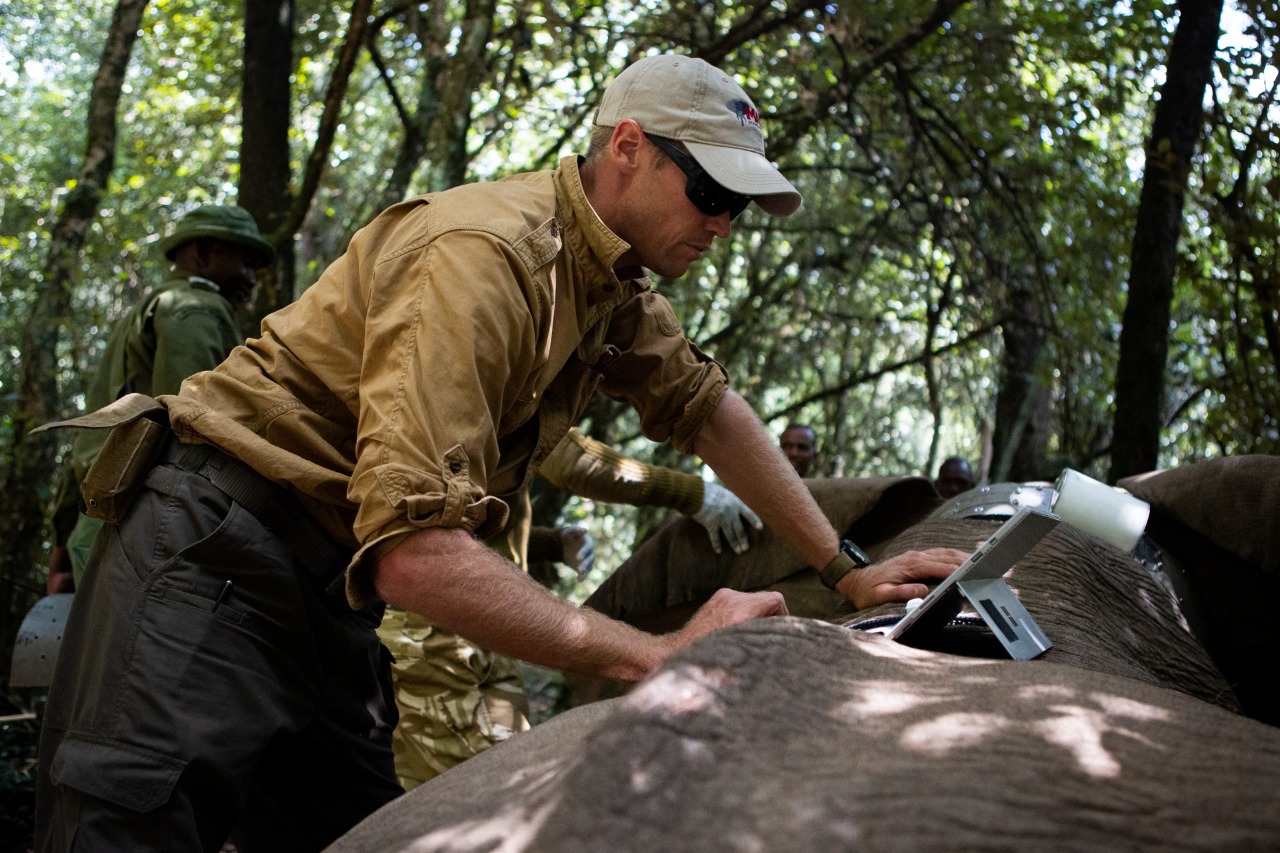
Caroline Collaring: The collaring operation for Kenya Wildlife Service and Mara Elephant Project elephant Caroline in May 2018. Photo Credit: Mara Elephant Project


Fitz Collaring: The collaring operation for Kenya Wildlife Service and Mara Elephant Project elephant Fitz sponsored by the Angama Foundation in the Nyakweri Forest in August 2019. Photo Credit: Mara Elephant Project

Fred: Kenya Wildlife Service and Mara Elephant Project collared elephant Fred; a large male that has been continuously tracked since 2012. Photo Credit: Mara Elephant Project

Ivy: Kenya Wildlife Service and Mara Elephant Project collared elephant Ivy; a habitual crop raider that has been continuously tracked since 2011. Photo Credit: Mara Elephant Project


Lucy: Kenya Wildlife Service and Mara Elephant Project collared elephant Lucy who was collared in April 2015 and monitored until September 2017. Photo Credit: Mara Elephant Project


Author Contact:

Nathan Hahn

Colorado State University

nhahn@rams.colostate.edu 

George Wittemyer

Colorado State University

g.wittemyer@colostate.edu 

Jake Wall

Mara Elephant Project

jake@maraelephantproject.org 

walljcg@gmail.com 

Kristen Denninger Snyder

Grumeti Fund

kristens@grumetifund.org 

Media Contacts:

Claire Bolles

Communications Director

Mara Elephant Project

claire@maraelephantproject.org 

317-440-0083

Jane Wynyard

Head of Communications 

Save the Elephants

jane@savetheelephants.org 

+254 (0) 708669635

Mary Guiden

Science Writer and Senior Public Relations Specialist

Colorado State University

mary.guiden@colostate.edu 

World Elephant Day 2021

Happy #WorldElephantDay! 2021
The wondrous world and existence of elephants is trumpeted today!
World Elephant Day has highlighted our coalition’s #IvoryFreeCanada campaign and consultation brought forth by the Canadian government to ban the trade of elephant ivory in Canada.
Please read the article below. #Donate to your favourite elephant organization and be sure to take in all the ‘elevents’ found on World Elephant Day website.
Mara Elephant Project is our elephant organization of choice to donate to.

https://worldelephantday.org/news/2021/08/o-canada-we-stand-to-ban-ivory?fbclid=IwAR17vrDMTO0Og_MOpC6daTcbGotruWUhvfiMeJTnApumTkBLEc_5mOdrue0