Until August 12th, every dollar you donate to Mara Elephant Project through this fundraiser will be matched by Elephanatics up to a total of $1200!
Tag: ecosytem
Elephanatics Newsletter July 2025
The Elephant Days of Summer!
Summer is here, a time for relaxation and reflection. Here are some wins and good news on our radar for our elephant lovers!
The Fran Duthie African Elephant Conservation Scholarship application for 2025 is now open and will be administered by the Mara Elephant Project. Accepting applications until the end of July, this scholarship provides financial support, and hands-on training for Kenyan students. The scholarship is intended for students pursuing conservation or a related field. The goal of this scholarship is to provide financial support to Kenyan nationals acquiring a technical certificate, undergraduate or postgraduate degree in an area related to conservation and the protection of wildlife. Alongside the financial support, this scholarship will provide practical experience to the scholar during their studies by undertaking a 1-month internship with a Kenyan conservation organization.
Apply today -> https://buff.ly/haSKLIw
We’re thrilled to share that The Mara Elephant Project is currently hosting recipient Mary Wangari at HQ for a one-month internship. Read more here.
It takes a village! A big elephantine thank you to Vegan Supply for once again letting us be their ‘jar donation’ recipient for the month of June. With their support we were able to raise funds to support our education and conservation programs. Vegan Supply is one of North America’s largest vegan online marketplaces.
Mark Your Calendars! August 12th is World Elephant Day!
#worldelephantday is a day that brings the world together to help elephants. This year Elephanatics is partnering with the Mara Elephant Project for WED to raise awareness and funds for the Loita Forest that forms the eastern part of the Greater Mara Ecosystem and is home to not just elephants but many rare species. The virgin, old-growth, afro-montane forest is one of the most beautiful and intact forests in East Africa. The forest faces significant threats, particularly from current subdivision of communal to private title deed ownership. This subdivision is causing land use change which accelerates the destruction of the forest jeopardizing the wildlife residing within and the surrounding rangelands. Your much needed donations will be matched and will fund critical activities to protect this area. Donate here.
Advocacy Alert
Working in collaboration with other global NGOs the Elephanatics team has sent letters to MPs and Federal Ministers regarding the urgent need for a global agreement, taking the form of an additional Protocol to the United Nations Convention against Transnational Organized Crime (UNTOC) to tackle the illegal wildlife trade.
Supporting the work of Global Initiative to end Wildlife Crime, Elephanatics will continue to engage and advocate for urgent action to be taken to bring to fruition a global treaty to combat the illegal trade by integrating offences into international criminal law. Read more here.
Fun Fact!
How can you tell the difference between elephant and mammoth ivory? To save elephant populations from extinction, the international community banned the sale of their ivory—but selling mammoth ivory remains legal, and the two are difficult to tell apart, especially for non-experts. This leaves a possible loophole for sellers of poached ivory to exploit. Now stable isotope analysis could provide a cheap, rapid option to speed up sample screening and stop the sale of elephant ivory! Read more here.
(Photo credit: Unsplash CCo Public Domain)
Enjoy the rest of the summer everyone!
Elephanatics Team
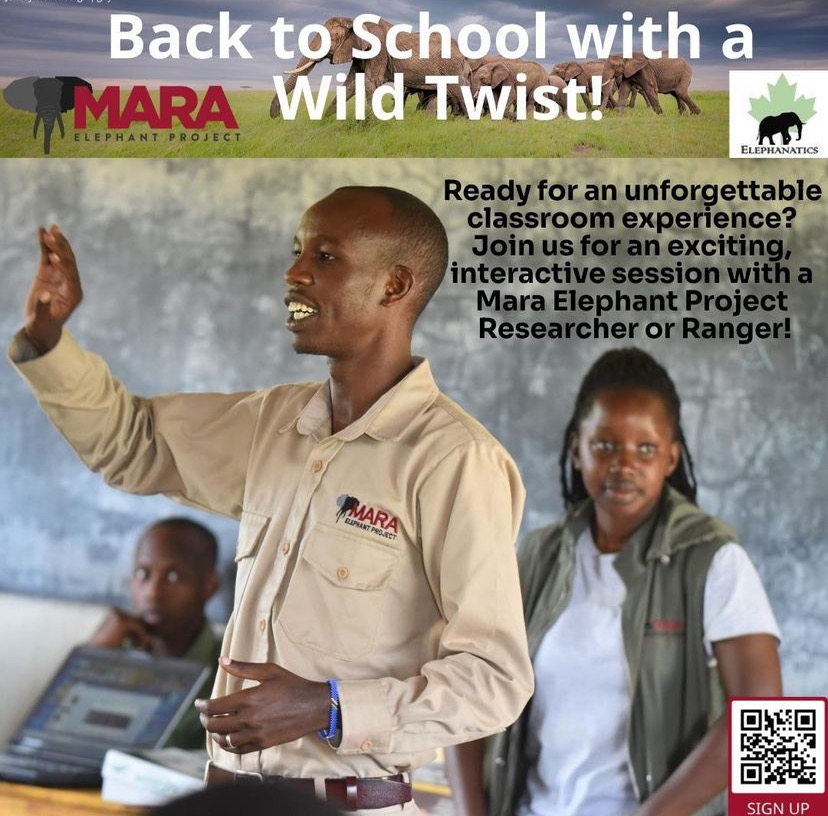
BRING A WILDLIFE RANGER OR RESEARCHER INTO YOUR CLASSROOM!
It’s Back To School and we have some great news for all educators!
Elephanatics and Mara Elephant Project are offering educators a unique opportunity to invite via Zoom a Mara Elephant Project ranger or researcher into your classroom. Students will have the chance to interact with a Kenyan conservationist and learn more about the work they are doing to protect elephants and their habitats in the Greater Mara Ecosystem.
Go to link below to book your spot today and share with fellow friends, teachers and educators!
Happy World Elephant Day 2023!
Celebrate #WorldElephantDay today by donating to your favourite elephant conservation organization!
#IvoryFreeCanada
#EarthDay #InvestInOurPlanet
The Canadian Federal Government Fails to Hold Canadian Companies Accountable Overseas
The Okavango River Basin covers 125,000 square miles across Angola, Botswana and Namibia and is home to the largest remaining population of African elephants, lions, leopards, rhinos, giraffe, African buffalo, and hundreds of species of birds. Its vast water system transforms what could be one of the driest areas in the world to a biodiversity hotspot hosting a vibrant landscape. In 2014 it became a Unesco World Heritage site.
While humanity faces the dual calamities of biodiversity loss and the impacts of a rapidly heating climate, the urgent need to safeguard biodiversity rich places such as the Okavango River Basin becomes more urgent.
The WWF Living Planet report shows that wildlife populations have declined by 69% over the last 50 years.
Indeed, while elephants roamed the forests and savannas of Africa in the millions in the past, the 20th century has seen an accelerated assault on their lives with populations declining from 10 million in the early 1900s to approximately 450,000 today. Climate change, human wildlife conflict, and poaching continue to devastate elephant populations.
As Canadians, why is it important that we act expeditiously to help protect the Okavango Delta from intrusions that would devastate this region?
We know that the world we inhabit is deeply interconnected. We are one planet.
The destruction of the Amazon forest impacts us all. The destruction of the Okavango Delta impacts us all.
The systems humans built have led us to this state of multiple crises. Now we must rebuild a path forward reprioritizing the needs of the planet as an interconnected place where the importance of flora and fauna are equally considered in economic development.
RECON AFRICA
Recon Africa is a small Canadian oil and gas-based exploration company that has begun drilling for oil and gas in this pristine basin. The news of its discovery increased share prices making a bundle for investors. The track record of Recon Africa has been suspect from the start, including stock manipulation, which has recently been extensively documented in Rolling Stone, and the Globe and Mail.
WHY SHOULD CANADIANS CARE?
The Canadian government cares about climate change. We know this because Canada signed on to the Paris Climate Agreement in 2016 pledging to reduce its greenhouse gas emissions by 30% below 2005 levels by 2030.
The Canadian government cares about biodiversity loss and is signatory to the first-ever biodiversity agreement. Among Canada’s main goals are protecting 30% of lands and waters by 2030, respecting the rights and roles of Indigenous peoples, and addressing the key drivers of biodiversity loss, such as pollution and overexploitation of nature. These elements were agreed upon in the final Framework.
With these large public commitments, it’s clear that Canada intends to play a leadership role on the global stage. In the recent federal budget the government committed millions to help industry and Canada transition to clean energy in response to the US Inflation Reduction Act.
CLOSE THE GAP – Canada does not have meaningful and enforceable oversight of how its corporations behave overseas, helping to ensure that collectively we will continue to fail our climate and biodiversity loss goals.
EMPOWER THE CANADIAN OMBUDSPERSON FOR RESPONSIBLE ENTERPRISE
Canada is home to many companies in the extractive sector, including over half of the worlds publicly listed mining companies. In 2018 CORE was launched to hold accountable laggard companies operating overseas. Although initially lauded as a big step toward corporate accountability that would hold mining and oil and gas companies accountable in extra territorial jurisdiction, in the last four years not a single case has been completed, meaning there have been zero investigations or reviews finished in CORE’s 4 years of operations.
Human rights and environmental groups have taken their complaints and concerns regarding Recon Africa’s corporate behavior to the RCMP and to unresponsive government departments.
Acting swiftly to close this gap would prevent 120 billion barrels of oil or 51.6 Gigatonnes of CO2, the equivalent of one sixth of the world’s remaining carbon budget, into the atmosphere.
It won’t matter what we do here if rogue resource sector businesses continue a trajectory of corporate malfeasance in other countries.
OPPORTUNITY AND NEXT STEPS
The Canadian government needs to give CORE the legal framework, power and resources to meaningfully hold companies accountable for environmental and human rights abuses in other countries.
Canada has the opportunity to lead the clean energy transition in Africa. Close the gaps and get serious about talking about climate change and protecting biodiversity. Everyone benefits from that.
Tessa Vanderkop
VP – Elephanatics
#EarthDay2023 #InvestInOurPlanet
Classroom Presentations at Art and Play Foundation!
Our student ambassador, Muskan, gave two informative and insightful presentations to the children attending the Art Therapy Program at Kids Play Foundation in Surrey last Saturday. The kids learned about the many faceted roles the elephant plays in keeping ecosystems in which they live healthy and their role as a keystone species. Lots of giveaways and fun was had by all.
Thank you, Muskan, for your great work. The elephants trumpet!!
Chapter 26 from Routledge Handbook of Rewilding
Chapter 26|10 pages – Routledge Handbook of Rewilding – publication Nov/22
* Rewilding, the wildlife trade and human conflict
This chapter examines the relationships between conflict, wildlife trade, and rewilding. Trade in wildlife, both legal and illegal, has increased exponentially in the last few decades, which has led, at least in part, to the decimation of numerous wildlife species, including keystone species that have an important role in the functioning of ecosystems. This affects trophic cascades, leading to the degradation of ecosystems and decreased ecosystem services. Conflict and civil strife have also been increasing globally. In most cases conflict results in a decline of species mainly through increased trade in wildlife for food and revenue, habitat degradation, and a breakdown in law and order. If rewilding is to be effective in restoring trophic cascades and ecosystem functioning, addressing the social and ecological impacts of conflict and wildlife trade should be seen as an integral part of rewilding. Interventions may include controlling trade and hunting, involving local communities, promoting sustainable wildlife use and curbing illegal wildlife trade.
To purchase book please go to: https://bit.ly/3WsxB64
Giving Tuesday November 29th
It’s Giving Tuesday November 29th
This #GivingTuesday we are asking you to help support the work of Elephanatics to build conservation educational capacity in Kenya by donating to the Fran Duthie African Elephant Conservation Scholarship held with Mara Elephant Project, an African conservation organization in Kenya dedicated to protecting elephants and their habitats.
The scholarship provides financial support to Kenyan nationals acquiring a technical certificate, undergraduate or postgraduate (Masters or PhD) degree in an area related to conservation and the protection of wildlife.
Janeth Jepkemboi was the first ever recipient of the scholarship.
Janeth began her master’s program at Karatina University studying environmental science. Janeth’s parents worked hard to put her through high school, and she helped by doing fundraisers. To pursue her undergraduate degree, she took out loans and worked throughout. Janeth was an exceptional candidate for this scholarship.
“My undergraduate studies in environmental studies made me passionate about conservation and I love connecting with nature. This scholarship is an opportunity for me to gain skills and academic excellence that I will use after as I envision working with a conservation organization and being at a level where I can influence policy to safeguard livelihoods while still protecting biodiversity values. This scholarship will be a great opportunity to realize my dreams and be an asset to the community.”
Janeth’s first semester consists of 7 units to include Conservation & Planning of Biological Resources, Environment & Development, among others. She is currently working on numerous assignments and term papers and will be writing her end of semester exams in January. We wish her every success and know she will do well.
The future of our wildlife depends on students, such as Janeth, to bring innovative change to conservation methods and modalities. We are all interdependent on nature for our own survival. Please consider investing in students who will provide the expertise necessary to make these changes.
* Please state in the comments section under ‘Donate Now’ that you would like your money deposited to the “Fran Duthie Scholarship”.
African Elephant Conservation Scholarship distributed by Mara Elephant Project!
We are excited to announce that Janeth Jepkemboi is the first ever recipient of the Fran Duthie African Elephant Conservation Scholarship distributed by Mara Elephant Project. Janeth is beginning her master’s program at Karatina University studying environmental science. Janeth’s parents worked hard to put her through high school, and she helped by doing fundraisers. To pursue her undergraduate degree, she took out loans and worked throughout. Janeth was an exceptional candidate for this scholarship generously supported by Fran Duthie and her family.
“My undergraduate studies in environmental studies made me passionate about conservation and I love connecting with nature. This scholarship is an opportunity for me to gain skills and academic excellence that I will use after as I envision working with a conservation organization and being at a level where I can influence policy to safeguard livelihoods while still protecting biodiversity values. This scholarship will be a great opportunity to realize my dreams and be an asset to the community.”