Human-elephant conflict is on the rise across Africa and is a major threat to wildlife conservation. Crops provide a highly nutritious food source, but elephants pursuing that source results in the destruction of farmer livelihoods, erodes human tolerance toward wildlife and manifests in retaliatory violence on crop-raiding elephants.
Crop conflict was assumed to be mostly carried out by a select few elephants, but managers have lacked the means to assess this at a detailed level. New research, however, offers a first look at long-term trends in crop-raiding behavior. Researchers found that habitual crop-raiding elephants are only a part of the problem.
The study was led by an international team of researchers from Colorado State University, Mara Elephant Project, Grumeti Fund, Tanzania Wildlife Research Institute, Kenya Wildlife Service and Save the Elephants. It was published Nov. 2 in the Journal of Animal Ecology.
Researchers said that the findings could help conservationists better understand elephant behavior and develop new mitigation methods to reduce human-elephant conflict.
The team used the time spent in crops each year to classify the raiding elephants’ behavior as:
- Rare, for 26% of elephants studied.
- Sporadic, for 34%.
- Seasonal, for 31%.
- Habitual, for 9% of the elephants.
Sporadic and seasonal elephants made up two-thirds of the population and accounted for 67% of agricultural use, while habitual individuals made up just 9% of the population and accounted for 32% of crop-raiding. The choice of tactics was not constant over time and elephants frequently changed tactics between years, which showed how the animals must balance the mortality risks and nutritional benefits of crop use at both daily and yearly scales. Only five of nine elephants remained habitual raiders for consecutive years.
Patterns of elephants accessing agriculture as a food source ‘remarkably consistent’
“Elephants are incredibly unique animals and populations and individuals within those populations vary markedly in the extent to which agriculture is utilized,” said Kristen Snyder, a conservation scientist at CSU and the Grumeti Fund, and a co-author of the new study. “But the patterns of how agriculture is accessed — nocturnally, and while moving quickly — is remarkably consistent across individuals and populations.”
Traditionally, researchers and managers believed only a small contingent of elephants was responsible for the majority of crop raiding, and as a result, management strategies have been designed to thwart them, explained Nathan Hahn, a doctoral student in ecology at CSU and lead author of the study.
Hahn said that the team wanted to assess how that expectation aligns with actual elephant behavior.
“It turns out crop-raiding is a lot more prevalent in the study populations than we knew previously,” he said. “In addition, patterns of conflict are complex because we saw that individuals frequently changed their agricultural use between years.”
The research team analyzed nine years of GPS tracking data from 66 collared elephants —32 male and 34 female — in collaboration with Kenya Wildlife Service and the Tanzania Wildlife Research Institute in the Serengeti-Mara Ecosystem. This ecosystem is a vast network of wildlife reserves, parks and community conservancies that straddles the Kenya-Tanzania border.
The GPS data was used to determine the extent to which each individual elephant used agriculture and assessed the animals’ perception of risk based on the raiding tactics they employed in comparison to their daily movement patterns.
A ‘silver bullet’ approach is elusive for a complex species
Jake Wall, director of research and conservation for Mara Elephant Project and affiliate faculty at CSU, said that by using GPS tracking coupled with remote-sensing agricultural spatial information, scientists now have a method for characterizing crop-raiding behaviour within a given elephant population.
“This in turn should help improve elephant crop-raiding mitigation strategies by wildlife managers,” he said.
Snyder said that the study’s findings can identify crop-raiding mitigation strategies that could have an impact and, just as importantly, eliminate those that do not suit the local context.
“In the western Serengeti, the high prevalence of agricultural use among the study population indicates that strategies targeting individual problem animals are unlikely to significantly reduce crop damage,” she explained.
Individual or small-scale approaches will make little difference if 80% of the local elephant population regularly utilize agriculture as a food source.
“Instead, solutions that prevent elephant access to farms across broad scales are required,” said Snyder.
CSU Professor George Wittemyer said that elephants employ complex, adaptive movement that balances their desire to access resources while avoiding threats. He is a senior author of this study and also serves as chairman of the scientific board for Save the Elephants.
“This research shows how that perceived balance differs between individuals, but also shifts over time for a given individual,” Wittemyer said. “This variation underpins the difficulty in solution oriented human-elephant coexistence measures. As we often find, a silver bullet is elusive for a species as complex and clever as elephants. We must be as adaptive as they are when trying to solve these problems.”
###
This work was supported by the National Science Foundation. Permissions for the Tanzania elephant collaring, and research were granted by Tanzania Wildlife Research Institute, Tanzania Commission for Science and Technology, Tanzania Wildlife Management Authority and Tanzania National Parks, and in Kenya by the Kenya Wildlife Service.
Journal of Animal Ecology, (author note): “Risk perception and tolerance shape variation in agricultural use for a transboundary elephant population” https://besjournals.onlinelibrary.wiley.com/doi/10.1111/1365-2656.13605 DOI: 10.1111/1365-2656.13605
Journal of Animal Ecology published by the British Ecological Society features the best animal ecology research that develops, tests and advances broad ecological principles. Visit https://besjournals.onlinelibrary.wiley.com/journal/13652656 to learn more.
…
Images:
Olchoda: Meaning “disturber” in Maa, Olchoda was collared in November 2016 by Kenya Wildlife Service and Mara Elephant Project in response to conflict in Pardamant Conservancy, a high conflict area. Photo Credit: Mara Elephant Project

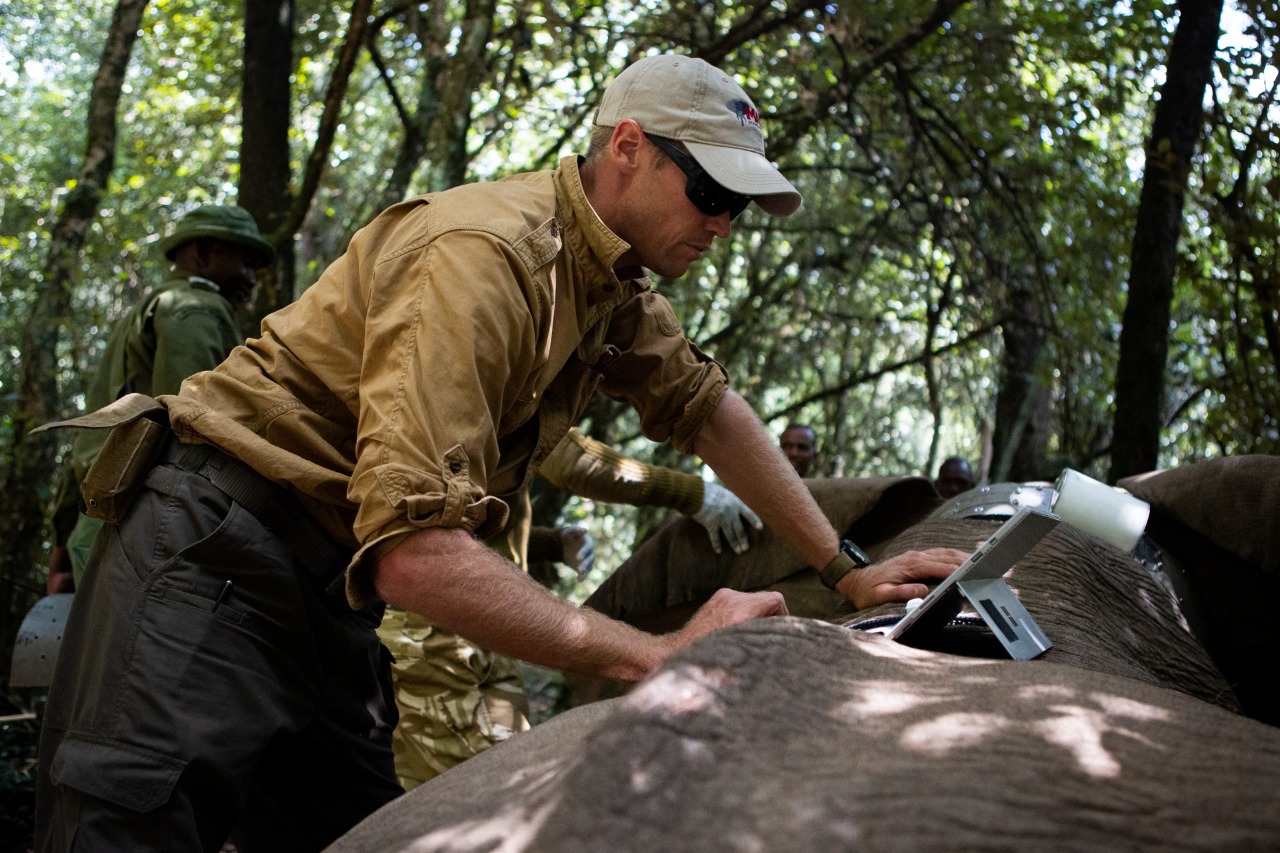
Caroline Collaring: The collaring operation for Kenya Wildlife Service and Mara Elephant Project elephant Caroline in May 2018. Photo Credit: Mara Elephant Project

Fitz Collaring: The collaring operation for Kenya Wildlife Service and Mara Elephant Project elephant Fitz sponsored by the Angama Foundation in the Nyakweri Forest in August 2019. Photo Credit: Mara Elephant Project

Fred: Kenya Wildlife Service and Mara Elephant Project collared elephant Fred; a large male that has been continuously tracked since 2012. Photo Credit: Mara Elephant Project

Ivy: Kenya Wildlife Service and Mara Elephant Project collared elephant Ivy; a habitual crop raider that has been continuously tracked since 2011. Photo Credit: Mara Elephant Project

Lucy: Kenya Wildlife Service and Mara Elephant Project collared elephant Lucy who was collared in April 2015 and monitored until September 2017. Photo Credit: Mara Elephant Project

Author Contact:
Nathan Hahn
Colorado State University
nhahn@rams.colostate.edu
George Wittemyer
Colorado State University
g.wittemyer@colostate.edu
Jake Wall
Mara Elephant Project
jake@maraelephantproject.org
walljcg@gmail.com
Kristen Denninger Snyder
Grumeti Fund
kristens@grumetifund.org
Media Contacts:
Claire Bolles
Communications Director
Mara Elephant Project
claire@maraelephantproject.org
317-440-0083
Jane Wynyard
Head of Communications
Save the Elephants
jane@savetheelephants.org
+254 (0) 708669635
Mary Guiden
Science Writer and Senior Public Relations Specialist
Colorado State University
mary.guiden@colostate.edu


 Leshan proactively pursued independent studies, utilizing online reading materials and peer discussions to advance his coursework.